

SLOW LEARNER HOMME QUI APPRENAIT LENTEMENT (L)
15,11 €
Épuisé
EAN :
9780099532514
| Date de parution | 01/04/2001 |
|---|---|
| Poids | 150g |
| Largeur | 130mm |

Distributor Debug Info
| SKU: | 9780099532514 |
| wmi_id_distributeur: | Not set |
| Is Salable (from plugin): | Yes (In Stock) |
| Is Salable (direct MSI check): | Yes (In Stock) |
| Distributor Name: | Par défaut |
| Availability Value: | 0 |
| Availability Label: | Epuisé |
| Match Result: | |
| Default Availability (Config): | 0 - Epuisé |
| Raw Config Mapping: |
Array
(
    [_1772119784121_121] => Array
        (
            [id] => 12707000
            [name] => 12707000
            [availability] => 1
            [activation_attribute] => 1
        )

)
|
Plus d'informations
| EAN | 9780099532514 |
|---|---|
| Titre | SLOW LEARNER HOMME QUI APPRENAIT LENTEMENT (L) |
| ISBN | 0099532514 |
| Auteur | PYNCHON THOMAS |
| Editeur | VINTAGE |
| Largeur | 130 |
| Poids | 150 |
| Date de parution | 20010401 |
| Nombre de pages | 0,00 € |
Pourquoi choisir Molière ?
Efficacité et rapidité Commandé avant 16h livré demain
Économique et pratique Livraison à domicile dès 5,10 €
Facile et sans frais Retrait gratuit en magasin
Sécurité et tranquillité Paiement 100 % sécurisé
Disponibilité et écoute Contactez-nous sur WhatsApp
Du même auteur
-

-

VINELAND VINELAND
Thomas Pynchon is the author of V., The Crying of Lot 49, Gravity's Rainbow, Slow Learner, Mason & Dixon and, most recently, Against the Day. He won the National Book Award for Gravity's Rainbow in 1974ÉPUISÉVOIR PRODUIT16,80 € -

L'Homme qui apprenait lentement
L'homme qui apprenait lentement, c'est évidemment Thomas Pynchon lui-même. Il s'en explique longuement dans l'introduction du volume, avec à la fois humilité - dénigrant mine de rien, pourfendant même tel ou tel aspect du texte - et minutie. Non seulement il y met en perspective les cinq nouvelles qui forment ce recueil, publiées de manière échelonnée dans des revues entre 1959 et 1964, et rassemblées ici dans l'ordre où elles furent écrites, tissant d'invisibles fils qui relient divers personnages ou bien des actions, des situations dont la complexité forme comme des "noeuds" dans son oeuvre, mais il appuie également ses considérations par des réflexions d'ordre stylistique ou des aperçus sur ce qui se passait alors aux Etats-Unis, dans une large frange émotionnelle qui mêle le monde déjà mythique du rock, la grande levée poétique des premiers livres du mouvement beat (On the Road, de Kerouac, est de 1957) et certaines passions très particulières à Thomas Pynchon lui-même et qui brassent aussi bien monde de l'enfance (Intégration secrète fait penser à Tom Sawyer), celui de l'espionnage (il dit avoir dévoré les livres de John Buchan, l'auteur des Trente-neuf Marches), les guides Baedeker, la mer sur les côtes de Long Island où Pynchon est né (en 1937), les journées de dérive et de beuverie des jeunes soldats, le T. S. Eliot de La Terre vaine, et enfin les lois de la thermodynamique et notamment celle de l'entropie, qui donne son titre à l'un des textes les plus célèbres de Pynchon. Les lecteurs de V. , ce monument littéraire des années 60 que nous rééditons en même temps que le présent volume, reconnaîtront dans la nouvelle intitulée Sous la rose une première version du futur chapitre 3 de V. C'est dire qu'ici nous avons affaire aux prémisses des oeuvres de la maturité, en compagnie d'un jeune écrivain qui cherche à savoir ce que l'intelligence qu'il a de son oeuvre lui réserve dans un proche avenir : V. est déjà en train de s'écrire, Vente à la criée du lot 49 n'est plus très loin. Ni non plus la formidable rumeur de folie de L'Arc-en-ciel de la gravité. Traduit de l'anglais (Etats-Unis) par Michel Doury.ÉPUISÉVOIR PRODUIT17,70 € -
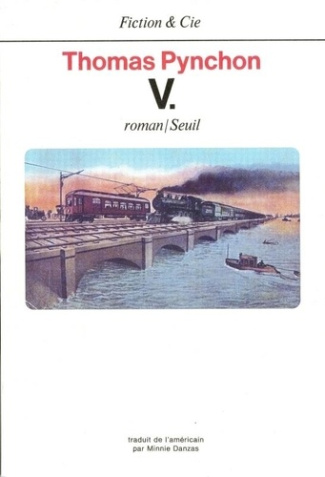
V
Chapter OneIn which Benny Profane,a schlemihl andhuman yo-yo,gets toan apo-cheirV Christmas Eve, 1955, Benny Profane, wearing black levis, suede jacket, sneakers and big cowboy hat, happened to pass through Norfolk, Virginia. Given to sentimental impulses, he thought he'd look in on the Sailor's Grave, his old tin can's tavern on East Main Street. He got there by way of the Arcade, at the East Main end of which sat an old street singer with a guitar and an empty Sterno can for donations. Out in the street a chief yeoman was trying to urinate in the gas tank of a "54 Packard Patrician and five or six seamen apprentice were standing around giving encouragement. The old man was singing, in a fine, firm baritone: Every night is Christmas Eve on old East Main,Sailors and their sweethearts all agree.Neon signs of red and greenShine upon the friendly scene,Welcoming you in from off the sea.Santa's bag is filled with all your dreams come true:Nickel beers that sparkle like champagne,Barmaids who all love to screw,All of them reminding you It's Christmas Eve on old East Main. 'Yay chief," yelled a seaman deuce. Profane rounded the corner. With its usual lack of warning, East Main was on him. Since his discharge from the Navy Profane had been roadlaboring and when there wasn't work just traveling, up and down the east coast like a yo-yo; and this had been going on for maybe a year and a half. After that long of more named pavements than he'd care to count, Profane had grown a little leery of streets, especially streets like this. They had in fact all fused into a single abstracted Street, which come the full moon he would have nightmares about. East Main, a ghetto for Drunken Sailors nobody knew what to Do With, sprang on your nerves with all the abruptness of a normal night's dream turning to nightmare. Dog into wolf, light into twilight, emptiness into waiting presence, here were your underage Marine barfing in the street, barmaid with a ship's propeller tattooed on each buttock, one potential berserk studying the best technique for jumping through a plate glass window (when to scream Geronimo? before or after the glass breaks?), a drunken deck ape crying back in the alley because last time the SP's caught him like this they put him in a strait jacket. Underfoot, now and again, came vibration in the sidewalk from an SP streetlights away, beating out a Hey Rube with his night stick; overhead, turning everybody's face green and ugly, shone mercury-vapor lamps, receding in an asymmetric V to the east where it's dark and there are no more bars. Arriving at the Sailor's Grave, Profane found a small fight in progress between sailors and jarheads. He stood in the doorway a moment watching; then realizing he had one foot in the Grave anyway, dived out of the way of the fight and lay more or less doggo near the brass rail. 'Why can't man live in peace with his fellow man,"wondered a voice behind Profane's left ear. It was Beatrice the barmaid, sweetheart of DesDiv 22, not to mention Profane's old ship, the destroyer U.S.S. Scaffold."Benny,"she cried. They became tender, meeting again after so long. Profane began to draw in the sawdust hearts, arrows through them, sea gulls carrying a banner in their beaks which read Dear Beatrice. The Scaffold-boat's crew were absent, this tin can having got under way for the Mediterranean two evenings ago amid a storm of bitching from the crew which was heard out in the cloudy Roads (so the yarn went) like voices off a ghost ship; heard as far away as Little Creek. Accordingly, there were a few more barmaids than usual tonight, working tables all up and down East Main. For it's said (and not without reason) that no sooner does a ship like the Scaffold single up all lines than certain Navy wives are out of their civvies and into barmaid uniform, flexing their beer-carrying arms and practicing a hooker's sweet smile; even as the N.O.B. band is playing Auld Lang Syne and the destroyers are blowing stacks in black flakes all over the cuckolds-to-be standing manly at attention, taking leave with me and a tiny grin. Beatrice brought beer. There was a piercing yelp from one of the back tables, she flinched, beer slopped over the edge of the glass. 'God," she said, "it's Ploy again." Ploy was now an engineman on the mine sweeper Impulsive and a scandal the length of East Main. He stood five feet nothing in sea boots and was always picking fights with the biggest people on the ship, knowing they would never take him seriously. Ten months ago (just before he'd transferred off the Scaffold) the Navy had decided to remove all of Ploy's teeth. Incensed, Ploy managed to punch his way through a chief corpsman and two dental officers before it was decided he was in earnest about keeping his teeth. "But think," the officers shouted, trying not to laugh, fending off his tiny fists: "root canal work, gum abscesses...." "No," screamed Ploy. They finally had to hit him in the bicep with a Pentothal injection. On waking up, Ploy saw apocalypse, screamed lengthy obscenities. For two months he roamed ghastly around the Scaffold...ÉPUISÉVOIR PRODUIT31,70 €


Du même éditeur
-

-
MUSIC AND SILENCE MUSIQUE ET SILENCE
Extrait Lilac and LindenA lamp is lit.Until this moment, when the flame of the lamp flares blue, then settles to steady yellow inside its ornate globe, the young man had been impressed by the profound darkness into which, upon his late-night arrival at the palace of Rosenborg, he had suddenly stepped. Tired from his long sea journey, his eyes stinging, his walk unsteady, he had been questioning the nature of this darkness. For it seemed to him not merely an external phenomenon, having to do with an actual absence of light, but rather as though it emanated from within him, as if he had finally crossed the threshold of his own absence of hope.Now, he is relieved to see the walls of a panelled room take shape around him. A voice says: 'This is the Vinterstue. The Winter Room.'The lamp is lifted up. Held high, it burns more brightly, as though sustained by purer air, and the young man sees a shadow cast onto the wall. It is a long, slanting shadow and so he knows it is his own. It appears to have a deformity, a hump, occurring along its spine from below the shoulder-blades to just above the waist. But this is the shadow's trickery. The young man is Peter Claire, the lutenist, and the curvature on his back is his lute.He is standing near a pair of lions, made of silver. Their eyes seem to watch him in the flickering gloom. Beyond them he can see a table and some tall chairs. But Peter Claire is separate from everything, cannot lean on any object, cannot rest. And now, the lamp moves and he must follow.'It may be', says a tall gentleman, who hurries on, carrying the light, 'that His Majesty, King Christian, will command you to play for him tonight. He is not well and his physicians have prescribed music. Therefore, members of the royal orchestra must be ready to perform at all times, day and night. I thought it best to advise you of this straight away.'Peter Claire's feelings of dismay increase. He begins to curse himself, to berate his own ambition for bringing him here to Denmark, for taking him so far from the places and people he had loved. He is at the end of his journey and yet he feels lost. Within this arrival some terrifying departure lies concealed. And suddenly, with peculiar speed, the lamp moves and everything in the room seems to rearrange itself. Peter Claire sees his shadow on the wall become elongated, stretching upwards for a few seconds towards the ceiling before being swallowed by the darkness, with no trace of it remaining.Then the end of a corridor is reached and the gentleman stops before a door. He knocks and waits, putting a finger to his lips and leaning close against the door to listen for the command from within. It comes at last, a voice deep and slow, and Peter Claire finds himself, in the next minute, standing before King Christian, who is sitting in a chair in his night-shirt. Before him, on a small table, is a pair of scales and by these a clutch of silver coins.The English lutenist bows as the King looks up and Peter Claire will always remember that, as King Christian first glimpses him in this dark middle of a winter's night, there comes into His Majesty's eyes a look of astonishment and, staring intently at the lute player's face, he whispers a single word: 'Bror.''I beg your pardon, Sir ...?' says Peter Claire.'Nothing,' says the King. 'A ghost. Denmark is full of ghosts. Did no one warn you?''No, Your Majesty.''Never mind. You will see them for yourself. We are one of the oldest nations on earth. But you should know that it is a time of storms here, of confusion, of incomprehension, of bitter boiling muddle.''Of muddle, Sir?''Yes. This is why I am weighing silver. I weigh the same pieces over and over again, to ensure that there is no error. No possibility of error. I am trying, piece by piece and day by day, to reimpose order upon chaos.'Peter Claire does not know how to reply to this and he is aware that the tall gentleman, without his noticing, has gone from the room, leaving him alone with the King, who now pushes the scales aside and settles himself more comfortably in the chair.King Christian lifts his head and asks: 'How old are you, Mr Claire? Where do you come from?'A fire is burning in the room, which is the Skrivestue, the King's study, and the small chamber smells sweetly of applewood and leather.Peter Claire replies that he is twenty-seven and that his parents live in the town of Harwich on the east coast of England. He adds that the sea in winter can be unforgiving there.'Unforgiving. Unforgiving!' says the King. 'Well, we must hurry on, pass over or skirt around that word. Unforgiving. But I tell you, lutenist, I am tortured by lice. Do not look alarmed. Not in my hair or on my pillow. I mean by cowards, rascals, liars, sots, cheats and lechers. Where are the philosophers? That is what I constantly ask.'Peter Claire hesitates before answering.'No need to reply,' says the King. 'For they are all gone from Denmark. There is not one left.'Then His Majesty stands up and moves towards the fire where Peter Claire is standing, and takes up a lamp and holds it near the young man's face. He examines the face and Peter Claire lowers his eyes because he has been warned not to stare at the King. This King is ugly. King Charles I of England, King Louis XIII of France, these are handsome men at this perilous moment in history, but King Christian IV of Denmark - all-powerful, brave and cultured as he is reported to be - has a face like a loaf.The lutenist, to whom, by cruel contrast, nature has given an angel's countenance, can smell wine on the King's breath. But he does not dare to move, not even when the King reaches up and tenderly touches his cheek with his hand. Peter Claire, with his blond hair and his eyes the colour of the sea, has been considered handsome from childhood. He wears this handsomeness lightly, frequently forgetting about it, as though almost impatient for time to take it away. He once overheard his sister Charlotte praying to God to be given his face in exchange for hers. He thought, it is really of little value to me; far better it were hers. And yet now, in this unfamiliar place, when his own thoughts are so sombre and dark, the lute player finds that his physical beauty is once again the subject of unexpected scrutiny.'I see. I see,' whispers the King. 'God has exaggerated, as He so often seems to do. Beware the attentions of my wife, Kirsten, who is a fool for yellow hair. I advise a mask when you are in her presence. And all beauty vanishes away, but of course you know that, I needn't underline the self-evident.''I know that beauty vanishes, Sir.''Of course you do. Well, you had better play for me. I suppose you know that we had your Mr Dowland here at court. The conundrum there was that such beautiful music could come from so agitated a soul. The man was all ambition and hatred, yet his ayres were as delicate as rain. We would sit there and blub, and Master Dowland would kill us with his furious look. I told my mother to take him to one side and say: ''Dowland, this will not do and cannot be tolerated,'' but he told her music can only be born out of fire and fury. What do you think about that?'Peter Claire is silent for a moment. For a reason he can't name, this question consoles him and he feels his agitation diminish by a fraction. 'I think that it is born out of fire and fury, Sir,' he says, 'but also out of the antitheses to these - out of cold reason and calm.''This sounds logical. But of course we do not really know where music comes from or why, or when the first note of it was heard. And we shall never know. It is the human soul, speaking without words. But it seems to cure pain - this is an honest fact. I yearn, by the way, for everything to be transparent, honest and true. So why do you not play me one of Dowland's Lachrimae? Economy of means was his gift and this I dote upon. His music leaves no room for exhibitionism on the part of the performer.'Peter Claire unslings his lute from his back and holds it close against his body. His ear (in which he wears a tiny jewel once given to him by an Irish countess) strains to hear, as he plucks and tunes. King Christian sighs, waiting for the sweet melody to begin. He is a heavy man. Any alteration of his body's position seems to cause him a fleeting moment of discomfort.Now Peter Claire arranges his body into the stance he must always adopt when he performs: leaning forward from the hips, head out, chin down, right arm forming a caressing half-circle, so that the instrument is held at the exact centre of his being. Only in this way can he feel that the music emanates from him. He begins to play. He hears the purity of the sound and suspects that this, alone, is what will count with the King of Denmark.When the song is over he glances at the King, but the King doesn't move. His wide hands clutch the arms of the chair. From the left side of his dark head falls a long, thin plait of hair, fastened with a pearl. 'In springtime,' Christian says suddenly, 'Copenhagen used to smell of lilac and of linden. I do not know where this heavenly scent has gone.'Kirsten Munk, Consort of King Christian IV of Denmark: From Her Private PapersWell, for my thirtieth birthday, I have been given a new Looking-glass which I thought I would adore. I thought I would dote upon this new Glass of mine. But there is an error in it, an undoubted fault in its silvering, so that the wicked object makes me look fat. I have sent for a hammer.My birthday gifts, I here record, were not as marvellous as the givers of them pretended they were. My poor old Lord and Master, the King, knowing my fondness for gold, gave me a little gold Statue of himself mounted on a gold horse and bearing a gold tilting pole. The horse, being in a prancing attitude, has his front legs lifted from the ground, so that the foolish thing would fall over, were it not for a small Harlequin pretending to run beside...ÉPUISÉVOIR PRODUIT14,50 € -
ATOMISED PARTICULES ELEMENTAIRES
Michel Houellebecq's dark and disturbing novel Atomised sees him establish himself as a unique and important voice in European letters. With his first work, Whatever, Houellebecq had created a sassy, street-wise bulletin of disaffected existentialism, and here that voice brilliantly extends its range. Atomised (from the French Les Particules élémentaires) is the story of two half-brothers, Michel and Bruno, who seem to represent two sides of Houellebecq himself (there are more than a few moments in the book where we feel we are reading a strange roman à clef). Michel, a molecular biologist, finds ordinary, human emotions inexplicable, making him seem abstruse and cold. Bruno is his opposite: a frustrated libertine trapped in a body most find repellant but still holding sex up as his most validating moment. Through these skewed archetypes an intricate, sometimes quite moving story of the brothers"lives is formed. Houellebecq obviously has a formidable intellect and, like the best French writers, manages to rail against anthropology, psychoanalysis, New Age philosophy and modern society in general without losing sight of his narrative--indeed the narrative is controlled quite beautifully, the pacing excellent, the switching from one brother's story to the other's done with a quiet grace. While some of Houellebecq's views are at the least questionable, and while there are moments when the conclusions to be drawn from his broadsides are disturbing, this never negates the value of the work. This is an ambitious book in which Houellebecq asks important questions: if sex is continually degraded by its increasing commodification and, concomitantly, genetics increasingly offers us the opportunity for procreation without recourse to it, where does that leave us? How do we navigate ourselves, afloat as we are, in this new moral universe? What does the increasing pace of scientific change mean to the conversations non-scientists have about our lives? What place does something called spirituality, whatever that means, have in this brave, new world? This is a big, bold, clever book that has already achieved more than cult status in France. Houellebecq should be read, and read carefully, if not always believed. --Mark Thwaite"ÉPUISÉVOIR PRODUIT15,11 € -
MARRIED MAN (THE) HOMME MARRIE (L )
Résumé : A middle-aged American, wary and on the rebound from a bruising affair, works out in a Paris gym - an ordinary day, except that he catches the eye of a stranger, Julien, a young French architect with a gleam in his eye. To Austin's amused astonishment, life takes on the colour of romance. As they dash between Bohemian suppers and glittering salons, all they have to deal with are comic clashes of cultures, of ages, of temperaments. But there is sadness in Julien's past and a grim cloud on the horizon. Soon, with increasing desperation, their quest for health and happiness drives them to Rome, Venice, Key West, Montreal and Providence - landscapes soaked with feeling which lead, in the end, to the bleak, baking sands of the Sahara.ÉPUISÉVOIR PRODUIT15,11 €


