

Tuto arduino uno. 45 projets électroniques originaux
Voici une série de projets Arduino Uno brillants et passionnants : alarme silencieuse, détecteur de présence humaine, luxmètre, commande d'un moteur, accès depuis l'internet et commande sans fil par liaison radio, etc. Contrairement à bien des schémas électroniques qu'on trouve gratuitement sur l'internet, ceux-ci ont été vérifiés et testés avec succès. Ce livre est aussi un mode d'emploi pour mettre en pratique ce que vous aurez appris avec ces 45 projets originaux. Ceux-ci sont faciles à réaliser et clairement décrits, avec des schémas et des photos. Les photos ont été faites avec des prototypes en fonction, elles témoignent de leur fiabilité. Combinez ces projets entre eux pour donner vie à vos propres idées. J'explique pourquoi chaque projet a été réalisé de cette façon et pas d'une autre. Ces informations et la description des composants utilisés vous faciliteront l'adaptation des montages à vos propres besoins. C'est précisément là que commencera pour vous l'aventure la plus passionnante. Pour finir, ce livre vous servira d'ouvrage de référence. L'index permet de trouver rapidement les projets où sont utilisées telle commande C++ ou telle fonction Arduino. Même lorsque vous aurez réalisé tous les projets, quels que soient votre niveau initial et celui que vous atteindrez en le lisant, vous garderez longtemps ce livre à portée de main pour le consulter régulièrement.
| Nombre de pages | 224 |
|---|---|
| Date de parution | 01/07/2016 |
| Poids | 380g |
| Largeur | 170mm |

| SKU: | 9782866612023 |
| wmi_id_distributeur: | 26005000 |
| Is Salable (from plugin): | No (Out of Stock) |
| Is Salable (direct MSI check): | No (Out of Stock) |
| Distributor Name: | Par défaut |
| Availability Value: | 0 |
| Availability Label: | Epuisé |
| Match Result: | |
| Default Availability (Config): | 0 - Epuisé |
| Raw Config Mapping: |
Array
(
    [_1772119784121_121] => Array
        (
            [id] => 12707000
            [name] => 12707000
            [availability] => 1
            [activation_attribute] => 1
        )

)
|
| EAN | 9782866612023 |
|---|---|
| Titre | Tuto arduino uno. 45 projets électroniques originaux |
| Auteur | Van Dam Bert ; Duchesnes Pascal |
| Editeur | PUBLITR ELEKTOR |
| Largeur | 170 |
| Poids | 380 |
| Date de parution | 20160701 |
| Nombre de pages | 224,00 € |
Pourquoi choisir Molière ?
Du même auteur
-

PIC Microcontrollers
Résumé : You can use it as projects book and build more thon 50 projects for your own use. The clear explanations, schematics, and pictures of each project on a breadboard make this a fun activity. You can also use it as a study guide. The technical background information in each project explains why the project is set up the way it is, including the use of datasheets This way you'll learn a lot about the project and the microcontroller being used, and you can expand the project to suit your own needs...making it ideal for use in schools and colleges. This book can also be used as a reference guide. The explanation of the JAL programming language and ail of the expansion libraries used is unique and found nowhere else. Using the index, you can easily locate projects that serve as examples for the main commands. But even after you've built all the projects it will still be a valuable reference guide to keep next to your PC. Four microcontrollers are discussed, the 12f675, 16f628, 16f876A, and 16f877, as well as how to migrate programs from one microcontroller to another. All software used in this book can be downloaded for free, including all of the source code, a program editor, and the JAL open source programming language. This powerful and yet easy to learn language is used by hobbyists and professionals worldwide. A hardware kit is also available for purchase separately that contains all the parts to get you started, including a few microcontrollers. There is even a free support website with additional information, FAQ, and links.ÉPUISÉVOIR PRODUIT38,00 € -
Intelligence artificielle. Imitation du comportement animal par des robots à microcontrôleurs PIC
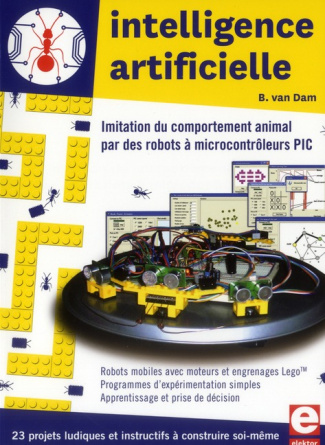
Vous êtes plutôt lion ? Alors vous apprendrez à chasser le gnou. Si vous êtes plutôt gazelle, apprenez à échapper au lion ! Et si vous n'êtes ni l'un ni l'autre, adoptez la stratégie de la fourmi, du ver ou du morpion. Les apparences sont trompeuses : ce livre, l'un des plus intelligents jamais publiés par Elektor, s'adresse bien aux passionnés d'électronique et de micro-informatique appliquées. Ne le croyez pas consacré aux théories abstraites. C'est au contraire un livre d'expérimentation, avec des circuits simples, des programmes simples, pour apprendre le biomimétisme à vos propres robots mobiles, construits avec des pièces de Lego. Il y est question de microcontrôleurs PIC, de programmation, de capteurs, de moteurs... mais aussi de morpions, de fourmis, de gnous, de vers, et d'autres bestioles. Vous y croiserez des robots joueurs, un robot chasseur par devant et vagabond par derrière. Dans les tribunes d'un stade de foot vous étudierez, les vagues de spectateurs qui se lèvent et se rassoient. Et vous reproduirez vous-même ces mouvements avec des LED. En vous familiarisant avec des robots à apprentissage autonome, qui comme un réseau neuronal apprendront à éviter les obstacles, ou des robots qui apprennent à se nourrir, c'est vous aussi qui apprendrez à apprendre. Dans ce livre, tout est élégant, même les vers de terre ; la mécanique, et quelle mécanique, avec par exemple un train à double différentiel ; les algorithmes génétiques ; les chromosomes et bien davantage de modèles vivants à étudier et à imiter.ÉPUISÉVOIR PRODUIT43,50 € -

L'agriculture bio en devenir
L'Alsace devient progressivement une région de pointe en matière d'agriculture biologique et pourrait être considérée comme une référence pour d'autres régions. Cet ouvrage analyse, à partir de points de vue divers, les conditions et les processus qui favorisent le développement du bio. S'appuyant sur une soixantaine d'interviews et de nombreux documents, les auteurs répondent à diverses questions : dans quelle mesure le bio répond-il à une nouvelle demande sociale ? Quel rôle jouent les émotions dans la mobilisation des acteurs ? Comment les collectifs contribuent-ils à la construction des savoirs ? Certaines contributions se penchent sur des dynamiques singulières, telle la place d'une coopérative laitière, ou celle d'une association de viticulteurs, ou encore la façon dont deux manifestations promotionnelles reflètent des sensibilités différentes. D'autres textes mettent en avant les disparités suivant les secteurs, les territoires et l'implication des individus, des associations ou des institutions. Au-delà de ces thèmes, la question des tensions entre modernité et tradition, entre individu et institution, entre mouvement social et institutionnalisation court tel un fil rouge dans les différents chapitres et montre la complexité du champ de l'agriculture biologique.ÉPUISÉVOIR PRODUIT54,00 € -

MICROCONTROLLER SYSTEMS ENGINEERING 45 PROJECTS FOR PIC AVR AND ARM - 45 PROJECTS FOR PIC, AVR AND A
Résumé : This book is about a state of the art tool, Flowcode, and how you can use Flowcode to develop microcontroller applications. The book starts very simply with a tutorial project and step-by-step instructions. As you go along the projects increase in difficulty and the new concepts are explained. Each project has a clear description of both hardware and software with pictures and diagrams, which explain not just how things are done but also why. Ail sources are available for free download. Since Flowcode is a high level language the intricacies of microcontroller programming are hidden from view. For that reason it doesn't make much difference whether the program is meant for a PIC, AVR or ARM microcontroller. On a high level the programs for these microcontrollers, although vastly different in internal structure, are identical. For that reason this book is on microcontroller application design in general, not just for one type of microcontroller. If you don't own the microcontroller described in a project you can usually convert it to another microcontroller quite easily. E-blocks will be used as hardware for the projects in this book. This way the hardware can be put together quickly and reliably. Fully tested units simply connect together using connectors or short flat ribbon tables to form completed projects. This book covers 45 exciting and fun projects for beginners and experts such as:ÉPUISÉVOIR PRODUIT40,00 €


Du même éditeur
-
MICROCONTROLLER SYSTEMS ENGINEERING 45 PROJECTS FOR PIC AVR AND ARM - 45 PROJECTS FOR PIC, AVR AND A
Résumé : This book is about a state of the art tool, Flowcode, and how you can use Flowcode to develop microcontroller applications. The book starts very simply with a tutorial project and step-by-step instructions. As you go along the projects increase in difficulty and the new concepts are explained. Each project has a clear description of both hardware and software with pictures and diagrams, which explain not just how things are done but also why. Ail sources are available for free download. Since Flowcode is a high level language the intricacies of microcontroller programming are hidden from view. For that reason it doesn't make much difference whether the program is meant for a PIC, AVR or ARM microcontroller. On a high level the programs for these microcontrollers, although vastly different in internal structure, are identical. For that reason this book is on microcontroller application design in general, not just for one type of microcontroller. If you don't own the microcontroller described in a project you can usually convert it to another microcontroller quite easily. E-blocks will be used as hardware for the projects in this book. This way the hardware can be put together quickly and reliably. Fully tested units simply connect together using connectors or short flat ribbon tables to form completed projects. This book covers 45 exciting and fun projects for beginners and experts such as:ÉPUISÉVOIR PRODUIT40,00 € -
Visual Basic for Electronics Engineering Applications
Résumé : The PC has longtime outgrown its function as a pure computer and has become an all-purpose machine. This book is targeted towards those people that want to control existing or self-built hardware from their computer. Using Visual Basic as Rapid Application Development tool we will take you on a journey to unlock the world beyond the connectors of the PC. After familiarizing yourself with Visual Basic, its development environment and the toolset it offers, items such as serial communications, printer ports, bitbanging, protocol emulation, ISA, USB and Ethernet interfacing and the remote control of test-equipment over the GPIB bus are covered in extent. Each topic is accompanied by clear, ready to run code, and where necessary, schematics are provided that will get your project up to speed in no time. This book will show you advanced things like: using tools like Debug to find hardware addresses, setting up remote communication using TCP/IP and UDP sockets and even writing your own internet servers. Or how about connecting your own block of hardware over USB or Ethernet and controlling it from Visual Basic. Other things like inter-program communication, DDE and the new graphics interface of Windows XP are covered as well. All examples are ready to compile using Visual Basic 5.0, 6.0, NET or 2005. Extensive coverage is given on the differences between what could be called Visual Basic Classic and Visual Basic NET / 2005.ÉPUISÉVOIR PRODUIT43,50 € -
-
