

MICROCONTROLLER SYSTEMS ENGINEERING 45 PROJECTS FOR PIC AVR AND ARM - 45 PROJECTS FOR PIC, AVR AND A
This book is about a state of the art tool, Flowcode, and how you can use Flowcode to develop microcontroller applications. The book starts very simply with a tutorial project and step-by-step instructions. As you go along the projects increase in difficulty and the new concepts are explained. Each project has a clear description of both hardware and software with pictures and diagrams, which explain not just how things are done but also why. Ail sources are available for free download. Since Flowcode is a high level language the intricacies of microcontroller programming are hidden from view. For that reason it doesn't make much difference whether the program is meant for a PIC, AVR or ARM microcontroller. On a high level the programs for these microcontrollers, although vastly different in internal structure, are identical. For that reason this book is on microcontroller application design in general, not just for one type of microcontroller. If you don't own the microcontroller described in a project you can usually convert it to another microcontroller quite easily. E-blocks will be used as hardware for the projects in this book. This way the hardware can be put together quickly and reliably. Fully tested units simply connect together using connectors or short flat ribbon tables to form completed projects. This book covers 45 exciting and fun projects for beginners and experts such as:
| Date de parution | 17/04/2009 |
|---|---|
| Poids | 545g |
| Largeur | 170mm |

| SKU: | 9780905705750 |
| wmi_id_distributeur: | Not set |
| Is Salable (from plugin): | No (Out of Stock) |
| Is Salable (direct MSI check): | No (Out of Stock) |
| Distributor Name: | Par défaut |
| Availability Value: | 0 |
| Availability Label: | Epuisé |
| Match Result: | |
| Default Availability (Config): | 0 - Epuisé |
| Raw Config Mapping: |
Array
(
    [_1772119784121_121] => Array
        (
            [id] => 12707000
            [name] => 12707000
            [availability] => 1
            [activation_attribute] => 1
        )

)
|
| EAN | 9780905705750 |
|---|---|
| Titre | MICROCONTROLLER SYSTEMS ENGINEERING 45 PROJECTS FOR PIC AVR AND ARM - 45 PROJECTS FOR PIC, AVR AND A |
| Auteur | VAN DAM BERT |
| Editeur | PUBLITR ELEKTOR |
| Largeur | 170 |
| Poids | 545 |
| Date de parution | 20090417 |
| Nombre de pages | 0,00 € |
Pourquoi choisir Molière ?
Du même auteur
-
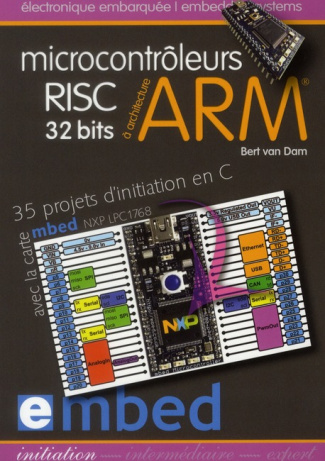
Microcontrôleurs RISC 32 bits à architecture ARM. 35 projets d'initiation en C avec la carte mbed NX
Peu importe que vous débutiez avec les microcontrôleurs ARM, les contrôleurs en général ou même avec le langage de programmation C, les projets de ce livre ont été conçus pour être réalisables aussi par des débutants. Cela ne signifie pas qu'il s'agit de projets simples, mais qu'ils sont faciles à comprendre. De fait, nous irons jusqu'à utiliser la communication USB, sujet a priori complexe mais que la carte mbed rend si facile à comprendre qu'il avait sa place ici. La plate-forme mbed et son microcontrôleur ARM, le NXP LPC1768, sont conçus pour l'informatique en nuage ou cloud Computing. Ce concept révolutionne le développement de logiciel : la programmation du microcontrôleur mbed ne nécessite en effet aucune installation de logiciel spécifique. Il suffit d'un navigateur Internet, par exemple Firefox ou Internet Explorer, et d'un port USB. Vous développerez désormais vos programmes à l'aide de votre navigateur et stockerez vos résultats dans le nuage, c'est-à-dire sur l'internet, afin de pouvoir y accéder depuis n'importe quel PC, où que vous vous trouviez. Une fois votre travail achevé, quelques clics suffiront à transférer dans votre microcontrôleur mbedle code exécutable par lui. Il n'est pas interdit de télécharger et de sauvegarder localement vos projets si vous préférez travailler de cette façon. Grâce aux explications sur les instructions du langage C, à la description des bibliothèques mbed, aux exemples de programmes et à son index, ce livre vous servira également de référence. Vous le garderez à portée de main, car il y est question aussi du traitement de signaux analogiques, de capteurs, de moteurs et de servomoteurs, d'interrupteurs et même de LED bleues ! www. elektor. fr/ ARM_initiationÉPUISÉVOIR PRODUIT40,00 € -

L'agriculture bio en devenir
L'Alsace devient progressivement une région de pointe en matière d'agriculture biologique et pourrait être considérée comme une référence pour d'autres régions. Cet ouvrage analyse, à partir de points de vue divers, les conditions et les processus qui favorisent le développement du bio. S'appuyant sur une soixantaine d'interviews et de nombreux documents, les auteurs répondent à diverses questions : dans quelle mesure le bio répond-il à une nouvelle demande sociale ? Quel rôle jouent les émotions dans la mobilisation des acteurs ? Comment les collectifs contribuent-ils à la construction des savoirs ? Certaines contributions se penchent sur des dynamiques singulières, telle la place d'une coopérative laitière, ou celle d'une association de viticulteurs, ou encore la façon dont deux manifestations promotionnelles reflètent des sensibilités différentes. D'autres textes mettent en avant les disparités suivant les secteurs, les territoires et l'implication des individus, des associations ou des institutions. Au-delà de ces thèmes, la question des tensions entre modernité et tradition, entre individu et institution, entre mouvement social et institutionnalisation court tel un fil rouge dans les différents chapitres et montre la complexité du champ de l'agriculture biologique.ÉPUISÉVOIR PRODUIT54,00 € -

-
ARTIFICIAL INTELLIGENCE - 23 PROJECTS TO BRING YOUR MICROCONTROLLER TO LIFE! INTELLIGENCE ARTIFICIEL
Résumé : This book contains 23 special and exciting artificiel intelligence machine-learning projects, for microcontroller and PC. Learn how to set up a neural network in a microcontroller, and how to make the network self-learning. Discover how you con breed robots, and how changing a fitness function results in a totally different behavior. Find out how a PC program exposes your weak spots in a game, and ruthlessly exploits them. Build a free-will robot, or have one clean your floor ! Example projects from the book : Microcontroller that learns what your favourite color is. Robot wandering about the house looking for someone to play with. Bred robot program that is incapable of crossing a black line. Microcontroller that learns how to play a game until You just can't win anymore. PC that programs a microcontroller all by itself. Complete with free software that you can download containing : All source code for the microcontroller. All sources of compiled PC programs (MS Windows). JAL programming language, with special editor and extension libraries. Robot breed program. Plus a support webpage with links, errata and FAQ. Several artificial intelligence techniques are discussed and used in projects such as expert system, neural network, subsumption, emerging behavior, genetic algorithm, cellular automata and roulette brains. Every project has clear instructions and pictures so you can start immediately. Suggestions and literature links allow you to go way beyond the scope of the book. Even after you have built all the projects contained within, this book will remain a valuable reference guide to keep next to your PC. A unique book for anyone with an interest in artificial intelligence and machine learning.ÉPUISÉVOIR PRODUIT35,00 €


Du même éditeur
-

UNIVERSAL DISPLAY BOOK FOR PIC MICROCONTROLLERS - MICROCONTROLEURS PIC ET AFFICHEURS
Résumé : The newcomer to Microchip's PIC microcontrollers invariably gets an LED to flash as their first attempt to master this technology. you can use just a simple LED indicator in order to show that your initial attempt is working, which will give you confidence to move forward. This is how the book begins - simple programs to flash LEDs, and eventually by stages to use other display indicators such as the 7-segment display, alphanumeric liquid crystal displays and eventually a colour graphic LCD. As the reader progresses through the book, bigger and upgraded PIC chips are introduced, with full circuit diagrams and source code, both in assembler and C. In addition, a small tutorial is included using the MPLAB programming environment, together with the EAGLE schematic and PCB design package to enable readers to create their own designs using the book's many case studies as working examples to work from.ÉPUISÉVOIR PRODUIT30,50 € -
PIC Microcontrollers
Résumé : You can use it as projects book and build more thon 50 projects for your own use. The clear explanations, schematics, and pictures of each project on a breadboard make this a fun activity. You can also use it as a study guide. The technical background information in each project explains why the project is set up the way it is, including the use of datasheets This way you'll learn a lot about the project and the microcontroller being used, and you can expand the project to suit your own needs...making it ideal for use in schools and colleges. This book can also be used as a reference guide. The explanation of the JAL programming language and ail of the expansion libraries used is unique and found nowhere else. Using the index, you can easily locate projects that serve as examples for the main commands. But even after you've built all the projects it will still be a valuable reference guide to keep next to your PC. Four microcontrollers are discussed, the 12f675, 16f628, 16f876A, and 16f877, as well as how to migrate programs from one microcontroller to another. All software used in this book can be downloaded for free, including all of the source code, a program editor, and the JAL open source programming language. This powerful and yet easy to learn language is used by hobbyists and professionals worldwide. A hardware kit is also available for purchase separately that contains all the parts to get you started, including a few microcontrollers. There is even a free support website with additional information, FAQ, and links.ÉPUISÉVOIR PRODUIT38,00 € -
