

Péri-PC. Tome 1, Votre PC et le reste du monde, avec 1 CD-ROM
Les deux volumes péri-PC 1 et péri-PC 2 proposent chacun une bonne vingtaine de circuits d'interface variés, à réaliser soi-même, pour faire communiquer n'importe quel PC avec le reste du monde. Il y a là des circuits de commande de lumière, de mesure de capacité d'accumulateur, de commande d'affichage, de programmation de PIC, mais aussi des articles de fond sur l'utilisation des bus CAN ou USB. Le livre donne les schémas complets avec la description de leur fonctionnement et des explications très fouillées, mais aussi la liste complète des composants et, pour chaque réalisation, un dessin de circuit imprimé de qualité professionnelle, facile à reproduire. Ainsi le lecteur intéressé pourra-t-il aisément passer à la pratique. Sur le CD-ROM offert avec le livre, se trouvent les programmes liés à chacune des applications, des listings, des tableaux de codes, mais aussi les fiches techniques (au format PDF) de la quasi totalité des circuits intégrés utilisés. Un certain nombre de platines sont disponibles prêtes à l'emploi et peuvent être commandées le cas échéant avec les composants programmés (bon de commande à la fin de chaque volume).
| Nombre de pages | 192 |
|---|---|
| Date de parution | 20/11/2002 |
| Poids | 367g |
| Largeur | 170mm |

| SKU: | 9782866611293 |
| wmi_id_distributeur: | Not set |
| Is Salable (from plugin): | Yes (In Stock) |
| Is Salable (direct MSI check): | Yes (In Stock) |
| Distributor Name: | Par défaut |
| Availability Value: | 0 |
| Availability Label: | Epuisé |
| Match Result: | |
| Default Availability (Config): | 0 - Epuisé |
| Raw Config Mapping: |
Array
(
    [_1772119784121_121] => Array
        (
            [id] => 12707000
            [name] => 12707000
            [availability] => 1
            [activation_attribute] => 1
        )

)
|
| EAN | 9782866611293 |
|---|---|
| Titre | Péri-PC. Tome 1, Votre PC et le reste du monde, avec 1 CD-ROM |
| Auteur | Meyer Denis |
| Editeur | PUBLITR ELEKTOR |
| Largeur | 170 |
| Poids | 367 |
| Date de parution | 20021120 |
| Nombre de pages | 192,00 € |
Pourquoi choisir Molière ?
Du même auteur
-

La naissance du politique
Résumé : Comment et pourquoi les Grecs, qui en ignoraient tout, créèrent-ils la démocratie ? L'école française, à cette question, répond par la seule explication du contexte : la crise sociale générale du monde grec au Ve siècle obligea les aristocraties à laisser le pouvoir au peuple. Mais donner le pouvoir au peuple implique que l'on ait d'abord inventé la notion de citoyen. C'est à cette lente genèse des nouveaux cadres de pensée qui, une fois la crise venue, permirent de jeter les bases de la démocratie, que ce livre s'attache, décrivant l'ample révolution culturelle que fut l'invention de la citoyenneté : la prééminence accordée à la communauté, l'importance prise par la participation politique dans la définition de l'identité de chacun, mais aussi, entres autres exemples, l'affirmation du libre-arbitre de l'homme dans la tragédie, Les Euménides d'Eschyle, ou la découverte, par Hérodote, que l'Histoire n'est pas un fil dévidé par les Dieux, mais un motif tissé par l'action des hommes.ÉPUISÉVOIR PRODUIT24,80 € -

MAITRISER L'ARGUMENTATION
Pourquoi cet ouvrage ? L'argumentation se trouve au cœur du fonctionnement de notre société, et ce à trois niveaux : politique : née en Grèce, elle est intimement liée à notre système démocratique. Un candidat ne peut bénéficier de la confiance de ses électeurs que s'il les a convaincus de la pertinence de ses analyses ; médiatique ; les médias, et notamment la télévision, présentent des interviews et des débats, habituant les téléspectateurs citoyens à apprécier et à discuter les arguments de chacun ; professionnel : en entreprise, les prises de décisions sont de plus en plus collectives ; à chacun de savoir défendre et imposer son point de vue lors des réunions, séminaires, etc. Destiné aux étudiants des premiers cycles universitaires (DEUG, DUT, BTS, CPGE), afin qu'ils soient mieux préparés aux examens, concours, mais aussi à leur insertion professionnelle, il s'adresse également aux adultes en formation continue et aux enseignants de lycée et collège.ÉPUISÉVOIR PRODUIT22,55 € -
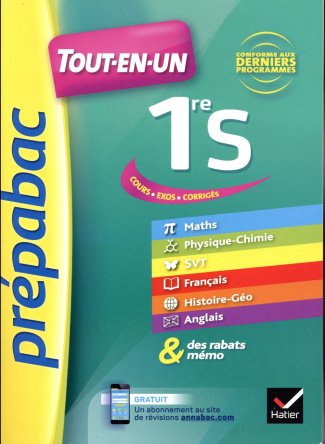
Tout-en-un 1re S
En un seul ouvrage, toutes les matières de la Première S : maths, physique-chimie, SVT, français, histoire-géo, anglais. - Dans chaque matière : - un cours structuré et illustré, - les méthodes clés, - des exercices et leurs corrigés. - Dans les rabats, un mémo pour le bac français : les oeuvres clés et une chronologie de la littérature française. - Avec ce Prépabac, vous pouvez également bénéficier d'un accès gratuit à toutes les ressources du site www. annabac. com : fiches de cours, podcasts audio et vidéo, quiz interactifs, sujets d'annales corrigés...ÉPUISÉVOIR PRODUIT15,80 €


Du même éditeur
-

UNIVERSAL DISPLAY BOOK FOR PIC MICROCONTROLLERS - MICROCONTROLEURS PIC ET AFFICHEURS
Résumé : The newcomer to Microchip's PIC microcontrollers invariably gets an LED to flash as their first attempt to master this technology. you can use just a simple LED indicator in order to show that your initial attempt is working, which will give you confidence to move forward. This is how the book begins - simple programs to flash LEDs, and eventually by stages to use other display indicators such as the 7-segment display, alphanumeric liquid crystal displays and eventually a colour graphic LCD. As the reader progresses through the book, bigger and upgraded PIC chips are introduced, with full circuit diagrams and source code, both in assembler and C. In addition, a small tutorial is included using the MPLAB programming environment, together with the EAGLE schematic and PCB design package to enable readers to create their own designs using the book's many case studies as working examples to work from.ÉPUISÉVOIR PRODUIT30,50 € -
MICROCONTROLLER SYSTEMS ENGINEERING 45 PROJECTS FOR PIC AVR AND ARM - 45 PROJECTS FOR PIC, AVR AND A
Résumé : This book is about a state of the art tool, Flowcode, and how you can use Flowcode to develop microcontroller applications. The book starts very simply with a tutorial project and step-by-step instructions. As you go along the projects increase in difficulty and the new concepts are explained. Each project has a clear description of both hardware and software with pictures and diagrams, which explain not just how things are done but also why. Ail sources are available for free download. Since Flowcode is a high level language the intricacies of microcontroller programming are hidden from view. For that reason it doesn't make much difference whether the program is meant for a PIC, AVR or ARM microcontroller. On a high level the programs for these microcontrollers, although vastly different in internal structure, are identical. For that reason this book is on microcontroller application design in general, not just for one type of microcontroller. If you don't own the microcontroller described in a project you can usually convert it to another microcontroller quite easily. E-blocks will be used as hardware for the projects in this book. This way the hardware can be put together quickly and reliably. Fully tested units simply connect together using connectors or short flat ribbon tables to form completed projects. This book covers 45 exciting and fun projects for beginners and experts such as:ÉPUISÉVOIR PRODUIT40,00 € -
COMPLETE PRACTICAL MEASUREMENT SYSTEMS USING A PC - CIRCUIT DESIGNS AND PROGRAMMING IN C# AND VISUAL
Résumé : This is a highly-practical guide for Hobbyists, Engineers and Scientists wishing to build measurement and control systems to be used in conjunction with a local or even remote Personal Computer. The book covers both hardware and software aspects of designing typical embedded systems based on personal computers running the Windows operating system. It's use of modern techniques in detailed, numerous examples has been designed to show clearly how straightforward it can be to create the interfaces between digital and analog electronics, programming and Web-design. Hardware developers will discover how use of latest high-level language constructs overcomes the need for specialist programming skills. Software developers will appreciate how a better understanding of circuits will enable them to optimize related programs, including drivers. There is no need to buy special equipment or expensive software tools in order to create embedded projects covered in this book. You can build such quality systems quickly using popular low-cost electronic components and free, distributed software tools. Some knowledge of basic electronics plus the very basics of C and C# programming only is required. With an emphasis on learning by doing, readers are encouraged by examples to program with ease; the book provides clear guidelines as to the appropriate programming techniques "on the fly". Complete and well-documented source code is provided for all projects. If you want to learn how to quickly build applications able to collect, process and display data on a PC from various analog and digital sensors, then even how to pass this data via a network and more then this is the book for youÉPUISÉVOIR PRODUIT35,00 € -
Visual Basic for Electronics Engineering Applications
Résumé : The PC has longtime outgrown its function as a pure computer and has become an all-purpose machine. This book is targeted towards those people that want to control existing or self-built hardware from their computer. Using Visual Basic as Rapid Application Development tool we will take you on a journey to unlock the world beyond the connectors of the PC. After familiarizing yourself with Visual Basic, its development environment and the toolset it offers, items such as serial communications, printer ports, bitbanging, protocol emulation, ISA, USB and Ethernet interfacing and the remote control of test-equipment over the GPIB bus are covered in extent. Each topic is accompanied by clear, ready to run code, and where necessary, schematics are provided that will get your project up to speed in no time. This book will show you advanced things like: using tools like Debug to find hardware addresses, setting up remote communication using TCP/IP and UDP sockets and even writing your own internet servers. Or how about connecting your own block of hardware over USB or Ethernet and controlling it from Visual Basic. Other things like inter-program communication, DDE and the new graphics interface of Windows XP are covered as well. All examples are ready to compile using Visual Basic 5.0, 6.0, NET or 2005. Extensive coverage is given on the differences between what could be called Visual Basic Classic and Visual Basic NET / 2005.ÉPUISÉVOIR PRODUIT43,50 €

