

WHITE MAN IN THE TREE
11,00 €
Épuisé
EAN :
9780099286745
| Date de parution | 12/12/2001 |
|---|---|
| Poids | 292g |
| Largeur | 129mm |

Distributor Debug Info
| SKU: | 9780099286745 |
| wmi_id_distributeur: | Not set |
| Is Salable (from plugin): | Yes (In Stock) |
| Is Salable (direct MSI check): | Yes (In Stock) |
| Distributor Name: | Par défaut |
| Availability Value: | 0 |
| Availability Label: | Epuisé |
| Match Result: | |
| Default Availability (Config): | 0 - Epuisé |
| Raw Config Mapping: |
Array
(
    [_1772119784121_121] => Array
        (
            [id] => 12707000
            [name] => 12707000
            [availability] => 1
            [activation_attribute] => 1
        )

)
|
Plus d'informations
| EAN | 9780099286745 |
|---|---|
| Titre | WHITE MAN IN THE TREE |
| ISBN | 0099286742 |
| Auteur | KURLANSKY MARK |
| Editeur | VINTAGE |
| Largeur | 129 |
| Poids | 292 |
| Date de parution | 20011212 |
| Nombre de pages | 0,00 € |
Pourquoi choisir Molière ?
Efficacité et rapidité Commandé avant 16h livré demain
Économique et pratique Livraison à domicile dès 5,10 €
Facile et sans frais Retrait gratuit en magasin
Sécurité et tranquillité Paiement 100 % sécurisé
Disponibilité et écoute Contactez-nous sur WhatsApp
Du même auteur
-

Locations meublées et investissements de loisirs
Cet ouvrage propose un tour d'horizon complet et très précis de la location meublée, qu'elle soit traditionnelle, à usage de résidence principale, saisonnière, en résidence de tourisme ou en résidence hôtelière. Dossier pluridisciplinaire juridique et fiscal, il passe en revue notamment les différentes modalités d'imposition des revenus locatifs et les réductions d'impôt. Il vous donne directement accès aux textes et à la jurisprudence.ÉPUISÉVOIR PRODUIT62,46 € -

La grande épopée du sel. Une histoire du monde
Terrestre ou maritime, le sel obsède l'humanité depuis des millénaires. Objet d'une quête acharnée et d'un commerce intense, il a suscité des guerres sans fin. Longtemps symbole de richesse et sujet à une spéculation outrancière, il pouvait dormir dans des caves antillaises, descendre à dos de yacks des hauteurs du Tibet, parcourir le désert saharien en plaques harnachées sur des dromadaires, se transformer en impôt pour financer les guerres pour les Chinois, les Romains ou les Français avec la gabelle, devenir monnaie d'échange pour les soldats, les ouvriers et les esclaves, privilège royal ou sinistre séjour pour les bagnards. Au XXe siècle, Gandhi n'hésitera pas à violer le monopole de l'occupant anglais sur le sel et sa courageuse .marche du sel, conduira l'Inde à l'indépendance... A l'aune de ce très disputé minéral, condiment et indispensable conservateur pour les pêcheurs au long cours, une incroyable histoire du monde se dessine...ÉPUISÉVOIR PRODUIT24,99 € -
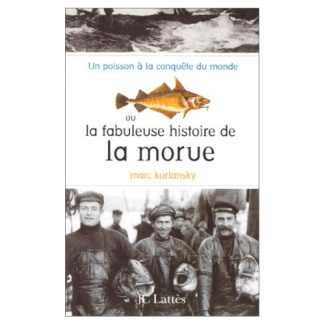
Un poisson à la conquête du monde ou La fabuleuse histoire de la morue
Pour elle, on a déclaré des guerres, déclenché des révolutions. Elle a été la base de l'alimentation de nations entières. Des économies en ont dépendu. Elle a accompagné la colonisation de l'Amérique du Nord. Pour les millions d'êtres qu'elle a fait vivre, elle a incarné un trésor plus précieux que l'or. La morue a ainsi joué un rôle fascinant et essentiel dans l'histoire du monde. Son épopée s'étend sur mille ans et quatre continents. Les Vikings la poursuivirent à travers l'Atlantique. Les Basques en firent commerce dès le Moyen Age. Elle fut l'emblème des vaisseaux de la Nouvelle-Angleterre et de Terre-Neuve comme des barques de pêcheurs côtiers, des élégants schooners comme des navires-usines labourant l'Atlantique. Des ports de l'Islande, de la Scandinavie, de l'Angleterre, aux rivages du Brésil et de l'Afrique occidentale, Mark Kurlansky ressuscite cette étonnante aventure. Sans oublier les recettes d'antan et d'aujourd'hui, il évoque les enjeux scientifiques et historiques, et finalement le drame d'un poisson, aujourd'hui au bord de l'extinction.ÉPUISÉVOIR PRODUIT26,80 €


Du même éditeur
-

BELOVED BELOVED
Extrait I124 WAS SPITEFUL. Full of a baby's venom. The women in the house knew it and so did the children. For years each put up with the spite in his own way, but by 1873 Sethe and her daughter Denver were its only victims. The grandmother, Baby Suggs, was dead, and the sons, Howard and Buglar, had run away by the time they were thirteen years old--as soon as merely looking in a mirror shattered it (that was the signal for Buglar); as soon as two tiny band prints appeared in the cake (that was it for Howard). Neither boy waited to see more; another kettleful of chickpeas smoking in a heap on the floor; soda crackers crumbled and strewn in a line next to the doorsill. Nor did they wait for one of the relief periods: the weeks, months even, when nothing was disturbed. No. Each one fled at once--the moment the house committed what was for him the one insult not to be borne or witnessed a second time. Within two months, in the dead of winter, leaving their grandmother, Baby Suggs; Sethe, their mother; and their little sister, Denver, all by themselves in the gray and white house on Bluestone Road. It didn't have a number then, because Cincinnati didn't stretch that far. In fact, Ohio had been calling itself a state only seventy years when first one brother and then the next stuffed quilt packing into his hat, snatched up his shoes, and crept away from the lively spite the house felt for them.Baby Suggs didn't even raise her head. From her sickbed she heard them go but that wasn't the reason she lay still. It was a wonder to her that her grandsons had taken so long to realize that every house wasn't like the one on Bluestone Road. Suspended between the nastiness of life and the meanness of the dead, she couldn't get interested in leaving life or living it, let alone the fright of two creeping-off boys. Her past had been like her present--intolerable--and since she knew death was anything but forgetfulness, she used the little energy left her for pondering color."Bring a little lavender in, if you got any. Pink, if you don't."And Sethe would oblige her with anything from fabric to her own tongue. Winter in Ohio was especially rough if you had an appetite for color. Sky provided the only drama, and counting on a Cincinnati horizon for life's principal joy was reckless indeed. So Sethe and the girl Denver did what they could, and what the house permitted, for her. Together they waged a perfunctory battle against the outrageous behavior of that place; against turned-over slop jars, smacks on the behind, and gusts of sour air. For they understood the source of the outrage as well as they knew the source of light.Baby Suggs died shortly after the brothers left, with no interest whatsoever in their leave-taking or hers, and right afterward Sethe and Denver decided to end the persecution by calling forth the ghost that tried them so. Perhaps a conversation, they thought, an exchange of views or something would help. So they held hands and said, "Come on. Come on. You may as well just come on."The sideboard took a step forward but nothing else did."Grandma Baby must be stopping it," said Denver. She was ten and still mad at Baby Suggs for dying.Sethe opened her eyes. "I doubt that," she said."Then why don't it come?""You forgetting how little it is," said her mother. "She wasn't even two years old when she died. Too little to understand. Too little to talk much even.""Maybe she don't want to understand," said Denver."Maybe. But if she'd only come, I could make it clear to her." Sethe released her daughter's hand and together they pushed the sideboard back against the wall. Outside a driver whipped his horse into the gallop local people felt necessary when they passed 124."For a baby she throws a powerful spell," said Denver."No more powerful than the way I loved her," Sethe answered and there it was again. The welcoming cool of unchiseled headstones; the one she selected to lean against on tiptoe, her knees wide open as any grave. Pink as a fingernail it was, and sprinkled with glittering chips. Ten minutes, he said. You got ten minutes I'll do it for free.Ten minutes for seven letters. With another ten could she have gotten "Dearly" too? She had not thought to ask him and it bothered her still that it might have been possible--that for twenty minutes, a half hour, say, she could have had the whole thing, every word she heard the preacher say at the funeral (and all there was to say, surely) engraved on her baby's headstone: Dearly Beloved. But what she got, settled for, was the one word that mattered. She thought it would be enough, rutting among the headstones with the engraver, his young son looking on, the anger in his face so old; the appetite in it quite new. That should certainly be enough. Enough to answer one more preacher, one more abolitionist and a town full of disgust.Counting on the stillness of her own soul, she had forgotten the other one: the soul of her baby girl. Who would have thought that a little old baby could harbor so much rage? Rutting among the stones under the eyes of the engraver's son was not enough. Not only did she have to live out her years in a house palsied by the baby's fury at having its throat cut, but those ten minutes she spent pressed up against dawn-colored stone studded with star chips, her knees wide open as the grave, were longer than life, more alive, more pulsating than the baby blood that soaked her fingers like oil."We could move," she suggested once to her mother-in-law."What'd be the point?" asked Baby Suggs. "Not a house in the country ain't packed to its rafters with some dead Negro's grief. We lucky this ghost is a baby. My husband's spirit was to come back in here? or yours? Don't talk to me. You lucky. You got three left. Three pulling at your skirts and just one raising hell from the other side. Be thankful, why don't you? I had eight. Every one of them gone away from me. Four taken, four chased, and all, I expect, worrying somebody's house into evil." Baby Suggs rubbed her eyebrows. "My firstborn. All I can remember of her is how she loved the burned bottom of bread. Can you beat that? Eight children and that's all I remember.""That's all you let yourself remember," Sethe had told her, but she was down to one herself--one alive, that is--the boys chased off by the dead one, and her memory of Buglar was fading fast. Howard at least had a head shape nobody could forget. As for the rest, she worked hard to remember as close to nothing as was safe. Unfortunately her brain was devious. She might be hurrying across a field, running practically, to get to the pump quickly and rinse the chamomile sap from her legs. Nothing else would be in her mind. The picture of the men coming to nurse her was as lifeless as the nerves in her back where the skin buckled like a washboard. Nor was there the faintest scent of ink or the cherry gum and oak bark from which it was made. Nothing. Just the breeze cooling her face as she rushed toward water. And then sopping the chamomile away with pump water and rags, her mind fixed on getting every last bit of sap off--on her carelessness in taking a shortcut across the field just to save a half mile, and not noticing how high the weeds had grown until the itching was all the way to her knees. Then something. The plash of water, the sight of her shoes and stockings awry on the path where she had flung them; or Here Boy lapping in the puddle near her feet, and suddenly there was Sweet Home rolling, rolling, rolling out before her eyes, and although there was not a leaf on that farm that did not make her want to scream, it rolled itself out before her in shameless beauty. It never looked as terrible as it was and it made her wonder if hell was a pretty place too. Fire and brimstone all right, but hidden in lacy groves. Boys hanging from the most beautiful sycamores in the world. It shamed her--remembering the wonderful soughing trees rather than the boys. Try as she might to make it otherwise, the sycamores beat out the children every time and she could not forgive her memory for that.When the last of the chamomile was gone, she went around to the front of the house, collecting her shoes and stockings on the way. As if to punish her further for her terrible memory, sitting on the porch not forty feet away was Paul D, the last of the Sweet Home men. And although she could never mistake his face for another's, she said, "Is that you?""What's left." He stood up and smiled. "How you been, girl, besides barefoot?"When she laughed it came out loose and young. "Messed up my legs back yonder. Chamomile."He made a face as though tasting a teaspoon of something bitter. "I don't want to even hear 'bout it. Always did hate that stuff."Sethe balled up her stockings and jammed them into her pocket. "Come on in.""Porch is fine, Sethe. Cool out here." He sat back down and looked at the meadow on the other side of the road, knowing the eagerness he felt would be in his eyes."Eighteen years," she said softly."Eighteen," he repeated. "And I swear I been walking every one of em. Mind if I join you?" He nodded toward her feet and began unlacing his shoes."You want to soak them? Let me get you a basin of water." She moved closer to him to enter the house."No, uh uh. Can't baby feet. A whole lot more tramping they got to do yet.""You can't leave right away, Paul D. You got to stay awhile.""Well, long enough to see Baby Suggs, anyway. Where is she?"''Dead.''"Aw no. When?""Eight years now. Almost nine.""Was it hard? I hope she didn't die hard."Sethe shook her head. "Soft as cream. Bein... --Ce texte fait référence à une édition épuisée ou non disponible de ce titre.ÉPUISÉVOIR PRODUIT13,60 € -

Amsterdam
Extrait Two former lovers of Molly Lane stood waiting outside the crematorium chapel with their backs to the February chill. It had all been said before, but they said it again."She never knew what hit her." "When she did it was too late." "Rapid onset." "Poor Molly." "Mmm."Poor Molly. It began with a tingling in her arm as she raised it outside the Dorchester Grill to stop a cab--a sensation that never went away. Within weeks she was fumbling for the names of things. Parliament, chemistry, propeller she could forgive herself, but less so bed, cream, mirror. It was after the temporary disappearance of acanthus and bresaiola that she sought medical advice, expecting reassurance. Instead, she was sent for tests and, in a sense, never returned. How quickly feisty Molly became the sickroom prisoner of her morose, possessive husband, George. Molly, restaurant critic, gorgeous wit, and photographer, the daring gardener, who had been loved by the foreign secretary and could still turn a perfect cartwheel at the age of forty-six. The speed of her descent into madness and pain became a matter of common gossip: the loss of control of bodily function and with it all sense of humor, and then the tailing off into vagueness interspersed with episodes of ineffectual violence and muffled shrieking.It was the sight now of George emerging from the chapel that caused Molly's lovers to move off farther up the weedy gravel path. They wandered into an arrangement of oval rose beds marked by a sign, THE GARDEN OF REMEMBRANCE. Each plant had been savagely cut back to within a few inches of the frozen ground, a practice Molly used to deplore. The patch of lawn was strewn with flattened cigarette butts, for this was a place where people came to stand about and wait for the funeral party ahead of theirs to clear the building. As they strolled up and down, the two old friends resumed the conversation they had had in various forms a half-dozen times before but that gave them rather more comfort than singing "Pilgrim."Clive Linley had known Molly first, back when they were students in '68 and lived together in a chaotic, shifting household in the Vale of Health."A terrible way to go."He watched his own vaporized breath float off into the gray air. The temperature in central London was said to be twelve degrees today. Twelve. There was something seriously wrong with the world for which neither God nor his absence could be blamed. Man's first disobedience, the Fall, a falling figure, an oboe, nine notes, ten notes. Clive had the gift of perfect pitch and heard them descending from the G. There was no need to write them down.He continued, "I mean, to die that way, with no awareness, like an animal. To be reduced, humiliated, before she could make arrangements, or even say goodbye. It crept up on her, and then . . ."He shrugged. They came to the end of the trampled lawn, turned, and walked back."She would have killed herself rather than end up like that," Vernon Halliday said. He had lived with her for a year in Paris in '74, when he had his first job with Reuters and Molly did something or other for Vogue."Brain-dead and in George's clutches," Clive said.George, the sad, rich publisher who doted on her and whom, to everyone's surprise, she had not left, though she always treated him badly. They looked now to where he stood outside the door, receiving commiseration from a group of mourners. Her death had raised him from general contempt. He appeared to have grown an inch or two, his back had straightened, his voice had deepened, a new dignity had narrowed his pleading, greedy eyes. Refusing to consign her to a home, he had cared for her with his own hands. More to the point, in the early days, when people still wanted to see her, he vetted her visitors. Clive and Vernon were strictly rationed because they were considered to make her excitable and, afterward, depressed about her condition. Another key male, the foreign secretary, was also unwelcome. People began to mutter; there were muted references in a couple of gossip columns. And then it no longer mattered, because the word was she was horribly not herself; people didn't want to go and see her and were glad that George was there to prevent them. Clive and Vernon, however, continued to enjoy loathing him.As they turned about again, the phone in Vernon's pocket rang. He excused himself and stepped aside, leaving his friend to proceed alone. Clive drew his overcoat about him and slowed his pace. There must be over two hundred in the black-suited crowd outside the crematorium now. Soon it would seem rude not to go over and say something to George. He got her finally, when she couldn't recognize her own face in the mirror. He could do nothing about her affairs, but in the end she was entirely his. Clive was losing the sensation in his feet, and as he stamped them the rhythm gave him back the ten-note falling figure, ritardando, a cor anglais, and rising softly against it, contrapuntally, cellos in mirror image. Her face in it. The end. All he wanted now was the warmth, the silence of his studio, the piano, the unfinished score, and to reach the end. He heard Vernon say in parting, "Fine. Rewrite the standfirst and run it on page four. I'll be there in a couple of hours." Then he said to Clive, "Bloody Israelis. We ought to wander over.""I suppose so."But instead they took another turn about the lawn, for they were there, after all, to bury Molly.With a visible effort of concentration, Vernon resisted the anxieties of his office. "She was a lovely girl. Remember the snooker table?"In 1978 a group of friends rented a large house in Scotland for Christmas. Molly and the man she was going about with at the time, a QC named Brady, staged an Adam and Eve tableau on a disused snooker table, he in his Y-fronts, she in bra and panties, a cue rest for a snake and a red ball for an apple. The story handed down, however, the one that had appeared in an obituary and was remembered that way even by some who were present, was that Molly "danced naked on Christmas Eve on a snooker table in a Scottish castle.""A lovely girl," Clive repeated.She had looked right at him when she pretended to bite the apple, and smiled raunchily through her chomping, with one hand on a jutting hip, like a music hall parody of a tart. He thought it was a signal, the way she held his gaze, and sure enough, they were back together that April. She moved into the studio in South Kensington and stayed through the summer. This was about the time her restaurant column was taking off, when she went on television to denounce the Michelin guide as the "kitsch of cuisine." It was also the time of his own first break, the Orchestral Variations at the Festival Hall. Second time round. She probably hadn't changed, but he had. Ten years on, he'd learned enough to let her teach him something. He'd always been of the hammer-and-tongs school. She taught him sexual stealth, the occasional necessity of stillness. Lie still, like this, look at me, really look at me. We're a time bomb. He was almost thirty, by today's standards a late developer. When she found a place of her own and packed her bags, he asked her to marry him. She kissed him, and quoted in his ear, He married a woman to stop her getting away/Now she's there all day. She was right, for when she went he was happier than ever to be alone and wrote the Three Autumn Songs in less than a month."Did you ever learn anything from her?" Clive asked suddenly.In the mid-eighties Vernon too had had a second bite, on holiday on an estate in Umbria. Then he was Rome correspondent for the paper he now edited, and a married man."I can never remember sex," he said after a pause."I'm sure it was brilliant. But I do remember her teaching me all about porcini, picking them, cooking them."Clive assumed this was an evasion and decided against any confidences of his own. He looked toward the chapel entrance. They would have to go across. He surprised himself by saying rather savagely, "You know, I should have married her. When she started to go under, I would have killed her with a pillow or something and saved her from everyone's pity."Vernon was laughing as he steered his friend away from the Garden of Remembrance. "Easily said. I can just see you writing exercise yard anthems for the cons, like what's-her-name, the suffragette.""Ethel Smyth. I'd do a damn better job than she did."The friends of Molly who made up the funeral gathering would have preferred not to be at a crematorium, but George had made it clear there was to be no memorial service. He didn't want to hear these three former lovers publicly comparing notes from the pulpits of St. Martin's or St. James's, or exchanging glances while he made his own speech. As Clive and Vernon approached they heard the familiar gabble of a cockt... --Ce texte fait référence à l'édition Broché .ÉPUISÉVOIR PRODUIT12,99 € -
-


