

SAFE AREA GORAZDE
Revue de presse "Sacco has produced a work that improbably manages to combine rare insight into what the war in Bosnia felt like on the ground with a mature and nuanced political and historical understanding of the conflict... Of the myriad books that have appeared about Bosnia, few have told the truth more bravely than Sacco. He is an immense talent, from whom we will hear a great deal more" (David Rieff New York Times Book Review)"Harrowing and bleakly humorous, Sacco's account of life during the Balkan conflict is a timeless portrait of ordinary people caught in desperate circumstances. It's also a work of genius in an unlikely genre: journalism in comic book form" (Utne Reader)"Like Art Spiegelman's Maus, Sacco's book juxtaposes the pop style of comics with human tragedy, making the brutality of war all the more jarring" (Time)
| Date de parution | 12/04/2007 |
|---|---|
| Poids | 620g |
| Largeur | 190mm |

| SKU: | 9780224080897 |
| wmi_id_distributeur: | Not set |
| Is Salable (from plugin): | Yes (In Stock) |
| Is Salable (direct MSI check): | Yes (In Stock) |
| Distributor Name: | Par défaut |
| Availability Value: | 0 |
| Availability Label: | Epuisé |
| Match Result: | |
| Default Availability (Config): | 0 - Epuisé |
| Raw Config Mapping: |
Array
(
    [_1772119784121_121] => Array
        (
            [id] => 12707000
            [name] => 12707000
            [availability] => 1
            [activation_attribute] => 1
        )

)
|
| EAN | 9780224080897 |
|---|---|
| Titre | SAFE AREA GORAZDE |
| Auteur | JOE SACCO |
| Editeur | JONATHAN CAPE |
| Largeur | 190 |
| Poids | 620 |
| Date de parution | 20070412 |
| Nombre de pages | 0,00 € |
Pourquoi choisir Molière ?
Du même auteur
-

-
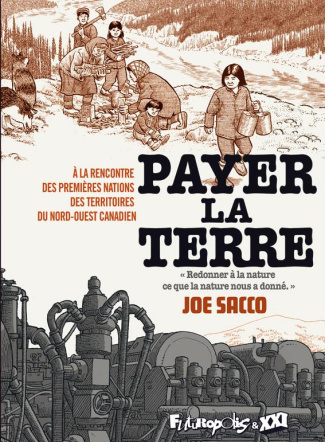
Payer la terre. A la rencontre des Premières Nations des territoires du nord-ouest canadien
4e de couverture : En 2015, Joe Sacco s'est rendu par deux fois dans les territoires du Nord-Ouest du Canada, au-dessous de l'Arctique. Il est allé à la rencontre des Denes, un peuple autochtone. L'auteur nous raconte l'histoire de ce peuple, ses traditions, restées intactes pour certaines, les premières rencontres avec les Anglais. Pendant longtemps, les peuples indigènes du Grand Nord, vivant sur des terres non propices à la colonisation agricole, restèrent livrés à eux-mêmes, jusqu'à ce que la découverte de pétrole et d'or incite le gouvernement à officialiser son autorité sur eux, comme sur leurs terres. À cette période, les autorités s'appropriaient les territoires, non plus par les massacres, mais cliniquement, méthodiquement, et de façon administrative - grâce à des traités. En lisant ceux-ci, on n'échappe pas à l'impression que les «Indiens» ont donné la terre où ils vivaient en échange de la promesse d'une annuité de quelques dollars, de quelques outils et de médailles pour ceux qui se disaient leurs chefs. Aujourd'hui, la fracturation hydraulique ajoute la pollution à la spoliation initiale.ÉPUISÉVOIR PRODUIT26,00 € -

FOOTNOTES IN GAZA
Revue de presse "Sacco has produced a series of extraordinary comic books that convey, with unusual attentiveness to the details of everyday life, the impact that war has on civilians" (Boston Globe)"Sacco is Art Spiegelman's most talented artistic descendant... [He] is tipped to win the comics world a second Pulitzer" (The Economist)"There is virtually no precedent for what he does... Sacco is legitimately unique" (The New York Review of Books)"Joe Sacco's brilliant, excruciating books of war reportage are potent territory... He shows how much that is crucial to our lives a book can hold" (Margo Jefferson The New York Times Book Review)ÉPUISÉVOIR PRODUIT30,00 € -

THE FIXER
Revue de presse "This tightly wound, humane and suspenseful non-fiction graphic novella employs visual devices from the best traditions of film noir. Sacco's finely wrought, expressively rendered black and white drawings perfectly capture the emotional character of Sarajevo and the people who struggle to live there. This superlative and important story is easily one of the best comics non-fiction works of the year" (Publishers Weekly)"Sacco is formidably talented. A meticulous reporter...and a gifted artist whose richly nuanced drawings tread a delicate path between cartoonishness and naturalism" (Charles Shaar Murray Independent)"Sacco's greatest achievement is to have so poignantly depicted oppression and horror in a form that manages to be both disarming and disquieting" (David Thompson Observer)"One of the most original cartoonists of the past two decades" (Duncan Campbell Guardian)ÉPUISÉVOIR PRODUIT18,50 €


Du même éditeur
-

-
-
GEMMA BOVERY
The Chunnel has made no difference. The French remain utterly foreign in English eyes, a peculiar and self-absorbed race that can give us cartoon books, call them la bande desinée and pretend they are as high an art form as, say, the novels of Gustave Flaubert. When plain English folk venture even as far as Normandy, they are letting themselves in for culture shock on a grand scale. Gemma is your average girl-about-London. Dumped by her ambitious lover, she rebounds onto a safe bet, gentle furniture restorer Charles Bovery. But Charles comes with an ex-wife and children and Gemma baulks at being the unpaid baby-sitter. When money falls into her lap, Gemma flees London and drags Charles to Normandy, where she spices up her increasingly dull marital life with a bit on the side named Patrick Large. But then she dies, under mysterious circumstances.The English would see this as poetic comeuppance for adultery and emigration, of course, but to Bailleville baker Raymond Joubert, it's a tragedy of epic proportions, as befits Gemma's namesake (OK, near-namesake), Emma Bovary. So, with brilliant novelistic pomposity, Joubert traces Gemma's life through the diaries she left, reading Gallic depth and meaning into every trite occurrence. Posy Simmonds is of course best known for her Posy cartoons in the Guardian, but if you have never believed you could get through an entire book of cartoons, think again. This is a brilliantly funny and beautifully sustained book, that in its very form skilfully illuminates the gaping void between English and French sensibilities. You don't need to know Flaubert to read Simmonds, but after reading this, then Madame Bovary is bound to be back on your wish list of Books You Always Meant to Read. --Alan StewartÉPUISÉVOIR PRODUIT17,00 €


