

Système 1 / Système 2. Les deux vitesses de la pensée
24,99 €
Épuisé
EAN :
9782081211476
Spécialiste en psychologie cognitive et en économie comportementale, Daniel Kahneman est professeur à l'université de Princeton. Ses travaux, menés en collaboration avec Amos Tversky, sur le jugement et la prise de décision, connaissent une grande influence dans de nombreux domaines - médecine, économie, politique notamment.
Catégories
| Nombre de pages | 560 |
|---|---|
| Date de parution | 28/09/2012 |
| Poids | 688g |
| Largeur | 152mm |

Distributor Debug Info
| SKU: | 9782081211476 |
| wmi_id_distributeur: | 12707000 |
| Is Salable (from plugin): | Yes (In Stock) |
| Is Salable (direct MSI check): | Yes (In Stock) |
| Distributor Name: | 12707000 |
| Availability Value: | 1 |
| Availability Label: | 2-4 jours |
| Match Result: |
Array
(
    [availability] => 1
    [name] => 12707000
    [active] => 1
)
|
| Default Availability (Config): | 0 - Epuisé |
| Raw Config Mapping: |
Array
(
    [_1772119784121_121] => Array
        (
            [id] => 12707000
            [name] => 12707000
            [availability] => 1
            [activation_attribute] => 1
        )

)
|
Plus d'informations
| EAN | 9782081211476 |
|---|---|
| Titre | Système 1 / Système 2. Les deux vitesses de la pensée |
| Auteur | Kahneman Daniel ; Clarinard Raymond |
| Editeur | FLAMMARION |
| Largeur | 152 |
| Poids | 688 |
| Date de parution | 20120928 |
| Nombre de pages | 560,00 € |
Pourquoi choisir Molière ?
Efficacité et rapidité Commandé avant 16h livré demain
Économique et pratique Livraison à domicile dès 5,10 €
Facile et sans frais Retrait gratuit en magasin
Sécurité et tranquillité Paiement 100 % sécurisé
Disponibilité et écoute Contactez-nous sur WhatsApp
Du même auteur
-
Noise. Pourquoi nous faisons des erreurs de jugement et comment les éviter
Résumé : Dès qu'il y a jugement, il y a bruit. Quand deux médecins posent des diagnostics différents pour le même patient, quand deux juges attribuent des peines plus ou moins lourdes pour le même crime, quand deux responsables de ressources humaines prennent des décisions opposées à propos d'un candidat à un poste, nous sommes face au bruit. Daniel Kahneman, Olivier Sibony et Cass R. Sunstein montrent dans ce livre que le bruit exerce des effets nocifs dans de nombreux domaines : médecine, justice, protection de l'enfance, prévision économique, recrutement, police scientifique, stratégie d'entreprise... Pourtant, le bruit reste méconnu. Il est la face cachée de l'erreur de jugement. Noise nous propose des solutions simples et immédiatement opérationnelles pour réduire le bruit dans nos jugements et prendre de meilleures décisions.EN STOCKCOMMANDER13,55 € -
Noise. Pourquoi nous faisons des erreurs de jugement et comment les éviter
Dès qu'il y a jugement, il y a bruit. Quand deux médecins posent des diagnostics différents pour le même patient, quand deux juges attribuent des peines plus ou moins lourdes pour le même crime, quand deux responsables de ressources humaines prennent des décisions opposées à propos d'un candidat à un poste, nous sommes face au bruit. Daniel Kahneman, Olivier Sibony et Cass R. Sunstein montrent dans ce livre que le bruit exerce des effets nocifs dans de nombreux domaines : médecine, justice, protection de l'enfance, prévision économique, recrutement, police scientifique, stratégie d'entreprise... Pourtant, le bruit reste méconnu. Il est la face cachée de l'erreur de jugement. Noise nous propose des solutions simples et immédiatement opérationnelles pour réduire le bruit dans nos jugements et prendre de meilleures décisions. Le prochain livre qui va changer votre façon de penser. Un best-seller mondial. "Un tour de force d'érudition et de clarté". The New York Times "Une leçon d'humilité devant nos erreurs". The Financial Times "Tous les chercheurs, les décideurs politiques, les dirigeants et les consultants devraient lire ce livre". The Washington PostÉPUISÉVOIR PRODUIT28,05 € -
Thinking fast and slow
There have been many good books on human rationality and irrationality, but only one masterpiece. That masterpiece is Daniel Kahneman's Thinking, Fast and Slow.Kahneman, a winner of the Nobel Prize for economics, distils a lifetime of research into an encyclopedic coverage of both the surprising miracles and the equally surprising mistakes of our conscious and unconscious thinking. He achieves an even greater miracle by weaving his insights into an engaging narrative that is compulsively readable from beginning to end. My main problem in doing this review was preventing family members and friends from stealing my copy of the book to read it for themselves...this is one of the greatest and most engaging collections of insights into the human mind I have read (William Easterly Financial Times )Absorbing, intriguing...By making us aware of our minds"tricks, Kahneman hopes to inspire individuals and organisations to identify strategies to outwit them (Jenni Russell Sunday Times )Profound... As Copernicus removed the Earth from the centre of the universe and Darwin knocked humans off their biological perch, Mr. Kahneman has shown that we are not the paragons of reason we assume ourselves to be (The Economist )[Thinking, Fast and Slow] is wonderful, of course. To anyone with the slightest interest in the workings of his own mind, it is so rich and fascinating that any summary would seem absurd (Michael Lewis Vanity Fair )It is an astonishingly rich book: lucid, profound, full of intellectual surprises and self-help value. It is consistently entertaining and frequently touching, especially when Kahneman is recounting his collaboration with Tversky... So impressive is its vision of flawed human reason that the New York Times columnist David Brooks recently declared that Kahneman and Tversky's work"will be remembered hundreds of years from now,"and that it is"a crucial pivot point in the way we see ourselves."They are, Brooks said,"like the Lewis and Clark of the mind'... By the time I got to the end of Thinking, Fast and Slow, my skeptical frown had long since given way to a grin of intellectual satisfaction. Appraising the book by the peak-end rule, I overconfidently urge everyone to buy and read it. But for those who are merely interested in Kahenman's takeaway on the Malcolm Gladwell question it is this: If you've had 10,000 hours of training in a predictable, rapid-feedback environment-chess, firefighting, anesthesiology-then blink. In all other cases, think (The New York Times Book Review )[Kahneman's] disarmingly simple experiments have profoundly changed the way that we think about thinking... We like to see ourselves as a Promethean species, uniquely endowed with the gift of reason. But Mr. Kahneman's simple experiments reveal a very different mind, stuffed full of habits that, in most situations, lead us astray (Jonah Lehrer The Wall Street Journal )This is a landmark book in social thought, in the same league as The Wealth of Nations by Adam Smith and The Interpretation of Dreams by Sigmund Freud (Nassim Nicholas Taleb, Author Of "the Black Swan" )Daniel Kahneman is among the most influential psychologists in history and certainly the most important psychologist alive today...The appearance of Thinking, Fast and Slow is a major event (Steven Pinker, Author Of The Language Instinct )Daniel Kahneman is one of the most original and interesting thinkers of our time. There may be no other person on the planet who better understands how and why we make the choices we make. In this absolutely amazing book, he shares a lifetime's worth of wisdom presented in a manner that is simple and engaging, but nonetheless stunningly profound. This book is a must read for anyone with a curious mind (Steven D. Levitt, Co-Author Of "freakonomics" )This book is a tour de force by an intellectual giant; it is readable, wise, and deep. Buy it fast. Read it slowly and repeatedly. It will change the way you think, on the job, about the world, and in your own life (Richard Thaler, Co-Author Of "nudge" )[A] tour de force of psychological insight, research explication and compelling narrative that brings together in one volume the high points of Mr. Kahneman's notable contributions, over five decades, to the study of human judgment, decision-making and choice... Thanks to the elegance and force of his ideas, and the robustness of the evidence he offers for them, he has helped us to a new understanding of our divided minds-and our whole selves (Christoper F. Chabris The Wall Street Journal )Thinking, Fast and Slow is a masterpiece - a brilliant and engaging intellectual saga by one of the greatest psychologists and deepest thinkers of our time. Kahneman should be parking a Pulitzer next to his Nobel Prize (Daniel Gilbert, Professor Of Psychology, Harvard University, Author Of "stumbling On Happiness', Host Of The Award-Winning Pbs Television Series"this Emotional Life")A major intellectual event... The work of Kahneman and Tversky was a crucial pivot point in the way we see ourselves (David Brooks The New York Times )Kahneman provides a detailed, yet accessible, description of the psychological mechanisms involved in making decisions (Jacek Debiec Nature )This book is one of the few that must be counted as mandatory reading for anyone interested in the Internet, even though it doesn't claim to be about that. Before computer networking got cheap and ubiquitous, the sheer inefficiency of communication dampened the effects of the quirks of human psychology on macro scale events. No more. We must now confront how we really are in order to make sense of our world and not screw it up. Daniel Kahneman has discovered a path to make it possible (Jaron Lanier, Author Of You Are Not A Gadget )For anyone interested in economics, cognitive science, psychology, and, in short, human behavior, this is the book of the year. Before Malcolm Gladwell and Freakonomics, there was Daniel Kahneman who invented the field of behavior economics, won a Nobel...and now explains how we think and make choices. Here's an easy choice: read this (The Daily Beast )I will never think about thinking quite the same. [Thinking, Fast and Slow] is a monumental achievement (Roger Lowenstein Bloomberg/Businessweek )A terrific unpicking of human rationality and irrationality - could hardly have been published at a better moment. Kahnemann is the godfather of behavioural economics, and this distillation of a lifetime's thinking about why we make bad decisions - about everything from money to love - is full of brilliant anecdote and wisdom. It is Kahnemann's belief that anyone who thinks they know exactly what is going on hasn't understood the question; as such it's the perfect gift for opinionated family members everywhere. (Tim Adams Observer Books of the Year )The book I most want to be given is Thinking, Fast and Slow by Daniel Kahneman. I'm a speedy thinker myself, so am hoping to be endorsed in that practice. (Sally Vickers Observer Books of the Year )In this comprehensive presentation of a life's work, the world's most influential psychologist demonstrates that irrationality is in our bones, and we are not necessarily the worse for it (10 Best Books Of 2011 New York Times )Selected by the New York Times as one of the 100 Notable Books of 2011 (New York Times )"EN STOCKCOMMANDER19,00 € -
Système 1 / Système 2. Les deux vitesses de la pensée, Edition actualisée
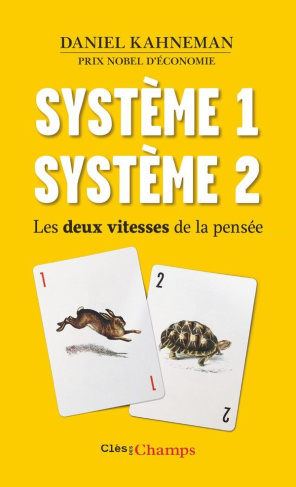
Comment prenons-nous nos décisions ? Qu'est-ce qui guide nos préférences et nos jugements ? Quand faut-il faire confiance à notre intuition ? Tels sont les fils rouges de cet ouvrage, dans lequel Daniel Kahneman nous emmène à la rencontre étonnante des deux "personnages" qui se partagent notre esprit. Le "Système 1" est rapide, intuitif et émotionnel ; le "Système 2" est lent, réfléchi et logique. Via de multiples expériences auxquelles le lecteur est invité à s'essayer lui-même, Daniel Kahneman expose les ravages des partis pris et autres biais cognitifs dont nous sommes les jouets : illusion de familiarité, effet de halo, biais optimiste, effet d'ancrage... Fruit de toute une vie de recherche, Système 1/Système 2 dessine une théorie brillante qui offre des prolongements pratiques immédiats dans la vie quotidienne et professionnelle.EN STOCKCOMMANDER14,70 €


Du même éditeur
-

L'ABCdaire de Van Eyck
Résumé : Damien Sausset est commissaire d'exposition, critique et journaliste.EN STOCKCOMMANDER4,95 € -
-
L'ABCdaire de l'art contemporain
Quand on voyage dans L'ABCdaire, le plaisir d'apprendre fait ricochet.ÉPUISÉVOIR PRODUIT4,95 € -
L'ABCdaire de la photographie
Pierre-Jean Amar est photographe créateur. Enseignant à l'Université de Provence, il est également l'auteur de plusieurs ouvrages sur la photographie.EN STOCKCOMMANDER4,95 €


De la même catégorie
-
Le sentiment d'incompréhension. Un jeu de cache-cache, 2e édition
Qui n'a jamais eu le sentiment d'être incompris alors même qu'il se rendait intelligible ? C'est précisément là où s'exprime un brouillage dans la transmission des messages que le besoin de compréhension est le plus grand. A l'instar d'un jeu de cache-cache, on tente de montrer sans se montrer, de faire sentir en provoquant, de se taire pour se faire entendre, de venir en aide pour être aidé, de s'isoler pour être trouvé, de prendre des risques pour être rassuré. Il y a bien des moyens de brouiller les cartes d'un jeu social qui engage notre identité. Pour pouvoir contrôler la situation, on veut, certes, être compris, mais pas par n'importe qui et pas à n'importe quel moment. L'auteure se propose de remonter aux sources de l'incompréhension pour appréhender ses modes d'expression et la quête de compréhension qui y est dissimulée.ÉPUISÉVOIR PRODUIT17,95 € -
L'entretien clinique
L'entretien clinique est au coeur du soin, au coeur du travail des soignants, en particulier en psychiatrie. Il entre dans l'univers de l'entretien psychologique. Dans l'entretien clinique, on verra comment ce qui est mobilisé diffère d'un théoricien à l'autre mais pour un même objectif ? : poser un diagnostic et conduire à une guérison ou à un soulagement des symptômes portés par le patient qu'ils s'agissent d'un enfant, d'un adolescent ou d'un adulte. Nous mentionnons l'originalité de Carl Rogers et son apport incontournable dans l'attitude, en particulier, que le clinicien doit avoir à l'égard de celui qui vint le solliciter et afin de lui apporter tout le réconfort, voire la guérison. Des définitions autour de la question : qu'est-ce qu'un entretien clinique ? Des théories. A quoi, à qui, peut-on rattacher l'entretien clinique ? Dix situations d'entretiens cliniques avec à l'appui quelques interprétations. Des outils nécessaires à la bonne conduite d'un entretien. La communication verbale et non-verbale dans l'entretien clinique. L'entretien clinique et le groupe familial. La formation à l'entretien clinique.ÉPUISÉVOIR PRODUIT12,90 € -
Mort de honte. La BD m'a sauvé
Résumé : Pour sortir de la honte, il faut accepter d'en passer par la rage. Sans elle, impossible de se reconstruire. Tel est le sens de ce récit autobiographique dans lequel Serge Tisseron évoque les hontes qui ont marqué son histoire : celle de ses origines sociales, d'une maladie vécue comme stigmatisante, d'un père écrasé par la faillite familiale. Car longtemps il a vécu avec ce sentiment sans en comprendre les causes réelles. Jusqu'à ce jour récent où, retrouvant une BD qu'il avait créée dans sa jeunesse, un secret enfoui se révèle à lui et lui donne la clé du mystère qui a nourri tout son travail. Le dessin l'a enfin sauvé de la honte. Dans la veine de Comment Hitchcock m'a guéri, ce récit-confidence dévoile la source inattendue des écrits de Serge Tisseron.ÉPUISÉVOIR PRODUIT18,45 € -
Vous êtes votre meilleur psy
Résumé : La peur de l'avion, le stress, l'insomnie, la timidité, le besoin de tout vérifier, la jalousie, l'hypocondrie ou les addictions de tous types... nous sommes nombreux à devoir y faire face à un moment ou à un autre de notre vie. Et il n'y a pas de honte à ça ! Ces phobies, angoisses, manies ou blocages ne sont pas forcément visibles, et on fait d'ailleurs tout pour les dissimuler. Pourtant, ils perturbent notre qualité de vie, c'est pourquoi il convient de s'y attaquer afin de corriger les mauvais plis pris au fil du temps. Nourri des connaissances scientifiques les plus récentes et de son expérience de médecin et de thérapeute, le professeur Antoine Pelissolo a rassemblé dans ce livre des principes et des méthodes concrètes dont l'efficacité est reconnue et que l'on peut appliquer par soi-même. Pour être mieux dans son corps et dans sa tête.ÉPUISÉVOIR PRODUIT19,00 €


