

Revue de littérature comparée N° 353, 1/2015
Christophe Corbier, Nietzsche, Brecht, Claudel : Roland Barthes face à la tragédie musicale grecque, RLCLXXXIX, n°1, janvier-mars 2015, p. 5-28. Du mémoire philologique de 1941 consacré aux scènes d'évocation et d'incantation dans la tragédie grecque jusqu'à l'analyse structuraliste du "théâtre grec" en 1965, Roland Barthes s'est régulièrement penché sur la tragédie musicale des Grecs afin de réfléchir au statut de la musique dramatique. Notre intention est donc d'étudier conjointement le théâtre et la musique dans une partie de l'oeuvre de Barthes avant 1968 et de montrer comment la tragédie grecque a constitué pendant près de trois décennies une référence constante, quoique méconnue. Barthes a en effet engagé très tôt un dialogue avec Nietzsche, avant de recevoir la révélation de Brecht ; mais il s'est aussi intéressé à Claudel, dont l'Orestie offre selon lui un modèle pour les représentations contemporaines de tragédie grecque, en dépit de la discontinuité fondamentale entre la Grèce antique et l'époque moderne. La théâtralité, le dionysiaque, le choeur, le rôle de la musique dramatique constituent alors autant de problèmes que l'auteur de Sur Racine analyse à plusieurs reprises entre 1941 et 1965, dans une perspective non aristotélicienne et antiromantique. Dimitri TOKAREV, Les illuminations d'un Rimbaud russe : Boris Poplavsky et son Journal d'Apollon Bézobrazov, RLCLXXXIX, n°1, janvier-mars 2015, p. 29-50. L'article est consacré aux échos de l'oeuvre de Rimbaud et surtout des Illuminations dans les poèmes en prose du poète et écrivain russe émigré Boris Poplavsky (1903-1935). Poplavsky, figure emblématique de la nouvelle génération des écrivains émigrés dite la "génération inaperçue" , était très sensible aux influences étrangères et voyait dans la personne de Rimbaud une parfaite incarnation de la poésie française qu'il essaya d'égaler en composant son Journal d'Apollon Bézobrazov. Atinati Mamatsashvili, Le signe de l'historicité dans la transformation de la parole poétique en acte poétique chez Francis Ponge et Giorgi Léonidzé, RLCLXXXIX, n°1, janvier-mars 2015, p. 51-64. Notre article se construit autour des textes poétiques conçus dans un espace politico-historique dissemblable. Dans Le Carnet du Bois de pin (1940) Francis Ponge aborde un objet qui ne comporte, à première vue, aucun signe distinctif historique, mais donne néanmoins lieu à l'émergence d'une temporalité déterminée. Le procédé adopté par Ponge fait écho à celui de Giorgi Léonidzé, poète symboliste géorgien (L'Arbre, 1931). Ce qu'on vise par ladite étude, c'est de démontrer par quels moyens méthodologiques et conceptuels le texte littéraire arrive à s'affranchir de l'historicité pour devenir pur texte poétique, tout en constituant, néanmoins, dans cet état même, le texte politique. Céline Roussel, Quand l'aveugle prend sa plume : dialectiques d'une écriture aveugle de soi, RLCLXXXIX, n°1, janvier-mars 2015, p. 65-76. L'article "Quand l'aveugle prend sa plume : dialectiques d'une écriture aveugle de soi" se propose d'examiner, à la lumière de réflexions de Derrida, les implications de la cécité sur l'écriture d'une oeuvre intime à partir de The Story of My Life de Helen Keller et de On Sight and Insight : A Journey into the World of Blindness de John M. Hull. Comment écrire, au sens le plus concret du terme, lorsqu'on ne voit pas ?? Qu'advient-il de cette texture, de cette corporéité donnée au texte grâce au braille lorsque l'oeuvre est publiée sous forme d'un livre ordinaire en noir et blanc ?? Les divers dédoublements que subit l'acte d'écriture ont une influence sur la proximité de l'auteur aveugle avec son oeuvre autobiographique, qui oscille entre le visible et l'invisible, le matériel et l'immatériel. Abstracts Christophe Corbier, Nietzsche, Brecht, Claudel : Roland Barthes on Greek Musical Tragedy, RLCLXXXIX (in French), no. 1, jan. -march 2015, p. 5-28. In this paper, we will study the relation between music and theater in a few texts of Roland Barthes, particularly his philological dissertation about Greek tragedy (1941), "Pouvoirs de la tragédie antique" (1953) and "Le théâtre grec" (1965). Firtsly, we will show how the concept of "théâtralité" is partially constructed on the basis of Barthes' interpretation of Aeschylean tragedy. Then, the prominent figure of Aeschylus leads him to a dialogue with Nietzsche, Brecht and Claudel, whose Orestie, written in the beginning of the twentieth century with Darius Milhaud, was always a model for Barthes. The French theoretician is interested in three main issues : music and its effects, Dionysius and the Dionysian, the chorus. After Nietzsche and Brecht, he proposes a non Aristotelian and anti-Romantic analysis of Greek tragedy ; therefore, this analysis could be compared to the contemporary researches of such Hellenists as George Thomson or Jean-Pierre Vernant. Dimitri TOKAREV, The illuminations of a Russian Rimbaud : Boris Poplavsky and his Journal of Apollo Bezobrazov, RLCLXXXIX (in French), no. 1, jan. -march 2015, p. 29-50. The article is devoted to the echoes of Rimbaud's oeuvre and especially the Illuminations in the prose poems by the Russian émigré poet and writer Boris Poplavsky (1903-1935). Poplavsky, an emblematic figure of the new generation of émigré writers known as the "unnoticed generation", was very sensible to foreign influences and considered Rimbaud as a perfect incarnation of the French poetry which he tried to match in his Journal of Apollo Bezobrazov. Atinati Mamatsashvili, The Sign of Historicity in the Transformation of the Poetic Word into the Poetic Act : Francis Ponge and Giorgi Léonidzé, RLCLXXXIX (in French), no. 1, jan. -march 2015, p. 51-64. Our article focuses on the poetic texts conceived in dissimilar politico-historical spaces. In the Le Carnet du Bois de pin (1940) Francis Ponge approaches an object which contains, at first sight, no historically distinguishing feature, but which nonetheless gives rise to the emergence of a definite temporality. The process adopted by Ponge echoes that of Giorgi Léonidzé, Georgian symbolist poet (The Tree, 1931). The purpose of this study consists in demonstrating by which methodological and conceptual means the literary text arrives to get over the historicity in order to appropriate the notion of the pure literary text, constituting, nevertheless, the political writing. Céline Roussel, When the blind take up their pens : the dialectics of a blind person'sautobiography, RLCLXXXIX (in French), no. 1, jan. -march 2015, p. 65-76. The article "When the blind take up their pens : the dialectics of a blind person's autobiography" seeks to examine, building on Derrida's analysis, the implications of blindness on the writing of an intimate work, taking The Story of My Life by Helen Keller and On Sight and Insight : A Journey into the World of Blindness by John M. Hull as its starting point. How can one write, in the most basic sense of the term, without being able to see ? What becomes of the texture, of the physical embodiment of a text written in braille, when the work is published as an ordinary book in black and white ? The various transformations which the act of writing undergoes have an influence on the proximity of the blind author to his autobiographical work, which fluctuates between the visible and the invisible, the tangible and the intangible.
| Nombre de pages | 128 |
|---|---|
| Date de parution | 05/09/2015 |
| Poids | 195g |
| Largeur | 150mm |

| SKU: | 9782252039861 |
| wmi_id_distributeur: | Not set |
| Is Salable (from plugin): | Yes (In Stock) |
| Is Salable (direct MSI check): | Yes (In Stock) |
| Distributor Name: | Par défaut |
| Availability Value: | 0 |
| Availability Label: | Epuisé |
| Match Result: | |
| Default Availability (Config): | 0 - Epuisé |
| Raw Config Mapping: |
Array
(
    [_1772119784121_121] => Array
        (
            [id] => 12707000
            [name] => 12707000
            [availability] => 1
            [activation_attribute] => 1
        )

)
|
| EAN | 9782252039861 |
|---|---|
| Titre | Revue de littérature comparée N° 353, 1/2015 |
| Auteur | Gély Véronique ; Brunel Pierre ; Pageaux Daniel-He |
| Editeur | KLINCKSIECK |
| Largeur | 150 |
| Poids | 195 |
| Date de parution | 20150905 |
| Nombre de pages | 128,00 € |
Pourquoi choisir Molière ?
Du même auteur
-

Revue de littérature comparée N° 347, 3/2013
Karen VANDEMEULEBROUCKE, La construction de la Flandre et du personnage flamand dans Bruges-la-Morte de Georges Rodenbach, RLC ?LXXXVII, n°?3, juillet-septembre 2013, p. ?267-282. Cet article est consacré à la représentation de la Flandre et du personnage flamand dans Bruges-la-Morte (1892) de Georges Rodenbach. Visant des effets différents selon les voix discursives - celle de l'auteur, celle du narrateur ou celle des différents personnages - elle relève d'une subtile opération de construction, ambivalente voire antithétique. A travers ses multiples voix discursives, Bruges-la-Morte révèle une construction stéréotypée de la Flandre et du personnage flamand mineur, à qui le(s) nar-rateur(s) dénie(nt) la voix. Carolina DEPETRIS, Découverte de la pensée mystique : Alejandra Pizarnik, Antonin Artaud, Miguel de Molinos, Simone Weil et Georges Bataille (in English), RLC ?LXXXVII, n°?3, juillet-septembre 2013, p. ?283-303. Dans les textes poétiques et critiques de la poète argentine Alejandra Pizarnik, il existe la forte conviction que l'exercice de l'écriture est étroitement lié à la recherche et recomposition d'un Absolu perdu. Cette conviction apparaît à partir de son livre Extracción de la piedra de la locura (1968) liée à la notion d' "?excès ?" comprise comme un acte nécessaire pour surpasser toutes les limites imposées à la poésie et à l'être poétique. La découverte de la pensée mystique d'auteurs - catholiques ou non- tels que Antonin Artaud, Miguel de Molinos, Simone Weil et Georges Bataille - a conduit Pizarnik à associer l'excès dans l'expression aux concepts de nudité et d'annihilation comme formes de plénitude poétique. Chloé CHAUDET, Peindre une autre réalité porteuse d'espoir : l'engagement au-delà de la dénonciation dans Dangerous Love de Ben Okri (1996) et Historias marginales de Luis Sepúlveda (2000), RLC LXXXVII, n°?3, juillet-septembre 2013, p. ?305-320. Cet article s'attache à démontrer que, si l'on porte son regard au-delà des frontières françaises, la notion d'engagement littéraire n'est pas (encore) surannée. Cette dernière peut en effet être appliquée à deux auteurs tels que Ben Okri, d'origine nigériane - qui commence seulement à être réellement lu en France, malgré son succès dans le domaine anglophone - et Luis Sepúlveda, dont le nom est à tort souvent associé exclusivement à la littérature pour la jeunesse. On considérera les textes Dangerous Love de Ben Okri (1996) et Historias marginales de Luis Sepúlveda (2000) pour voir dans quelle mesure une conception transhistorique et transculturelle de l'engagement littéraire comme "?dénonciation d'un inacceptable ?" peut s'y appliquer. Si les deux textes se fondent sur une telle dénonciation, ils s'inscrivent en fait dans un projet plus étendu, que nous souhaiterions mettre au jour. Caroline ANDRIOT-SAILLANT, La voix lointaine de Rilke dans l'oeuvre d'Yves Bonnefoy ? : poétiques comparées du chant et de la danse, RLC LXXXVII, n°?3, juillet-septembre 2013, p. ?321-341. La méditation d'Yves Bonnefoy dans Le Sommeil de personne (2004) a pour origine la lecture de l'épitaphe de Rilke : il y décèle une abolition de la personne et de sa finitude dans un absolu, celui de la beauté. Yves Bonnefoy se démarque de ce qu'il nomme "?un déni du savoir de la mort ?" . L'examen de la réflexion métalinguistique des deux poètes sur la notion de "symbole" nous amène à confronter, dans la poésie de Rilke, la recherche d'une complétude sur fond d'anéantissement, à la quête poétique du "?réel ?" , en tant que concrétude de la chose finie, chez Yves Bonnefoy. Deux poétiques de la voix font écho à ces deux vocations du poème. Différentes figures leur donnent corps ? : Orphée chez Rilke, Coré, puis la "?voix lointaine ?" de la mère dans Les Planches courbes d'Yves Bonnefoy. La voix en mouvement régit une poétique de l'écriture dansée : elle est à l'origine, aussi bien des Sonnets à Orphée, que des Planches courbes hantées par des ombres dansantes. La comparaison de ces paradigmes, à partir de la lecture de Rilke par Bonnefoy, donne à entendre une inquiétude métaphysique qui se convertit en recherche esthétique et en exigence éthique.ÉPUISÉVOIR PRODUIT20,00 € -
Revue de littérature comparée N° 351, 3/2014
Victoire Feuillebois, Pourquoi des fictions autour de la musique ? L'exemple du Sanctus d'Hoffmann, RLC ?LXXXVIII, n°?3, juillet-septembre 2014, p. ?259-284 L'article s'interroge sur un aspect narratif particulier des Künstlernovellen romantiques sur la musique ? : sur le plan narratif, la fiction se déploie ainsi souvent sur deux plans - celui du cadre enchâssant qui est le lieu de la transmission du récit dans un environnement mondain et sociable, et celui de l'histoire insérée qui est souvent la scène de la composition ou de la représentation d'une oeuvre originale et profondément atypique. L'objectif de l'article est de redonner sens à cette figuration apparemment contre-productive de la création en étudiant la nouvelle d'E. T. A. Hoffmann Le Sanctus. Plutôt que de souligner la vanité tragique de toute production géniale, ce dispositif illustre selon nous le credo esthétique du romantisme, qui consiste à faire de l'art un absolu autonome et indépendant du milieu dans lequel il apparaît, tout en maintenant qu'en raison même de son caractère sublime et apparemment détaché, il possède un pouvoir d'effectivité accru. Victoire Feuillebois, Why Frame Music in Fictions ? The Example of Hoffmann's Sanctus, RLC ?LXXXVIII (in French), no. ?3, july-sept. 2014, p. ?259-284. The article deals with the specific narrative aspect of the romantic Künstlernovellen about music. Narration-wise, these fictions are often built on two levels : the frame narrative, where the tale is told in a sociable environment, and the enshrined narrative where an original and profoundly atypical piece is often composed or represented. This paper aims to give another meaning to this apparently counter-productive representation of creation through the study of E. T. A. Hoffmann's Sanctus. Rather than to underline the tragical vanity of all production of genius, in our opinion this literary device illustrates the aesthetical credo of Romanticism. According to the latter, art is an autonomous absolute which is independent from the milieu in which it appears, while at the same time, because of its very sublime and apparently detached nature, it possesses an increased power of effectiveness. Alexia Kalantzis, A la recherche d'un modèle éditorial : les revues de Giovanni Papini et les revues françaises à l'aube du XXe siècle, RLC ?LXXXVIII, n°?3, juillet-septembre 2014, p. ?285-310. Les revues florentines créées par Giovanni Papini au début du xxe siècle s'inscrivent dans la lignée du modèle éditorial de la revue moderniste tel qu'il apparaît dans les "petites revues" parisiennes. On y retrouve l'hybridité du support, qui oscille entre la revue et le journal, le mélange entre la modernité et le caractère ancien de l'objet-livre, ainsi qu'un même projet de rénovation culturelle fondée sur la jeunesse et l'autonomie éditoriale. Dans les échanges entre les revues parisiennes et florentines, Remy de Gourmont apparaît comme une figure privilégiée de passeur. Sa théorie de la dissociation des idées, bien connue des milieux avant-gardistes italiens, ouvre en effet la voie à une rhétorique particulière, que l'on retrouvera notamment dans les fragments de la revue Lacerba. Alexia Kalantzis, Searching for an Editorial Model : Giovanni Papini's Magazines and French Magazines at the Dawn of the Twentieth Century, RLC ?LXXXVIII (in French), no. ?3, july-sept. 2014, p. ?285-310. The Florentine magazines created by Giovanni Papini in the early twentieth century are belong to the tradition of the editorial style of modernist magazines as seen in "little magazines" from Paris. They include the hybridity of the medium oscillating between magazine and newspaper, and the combination of modernity and the former nature of the book as object. They also belong to the same project of cultural revival based on youth and editorial independence. In the exchanges between Parisian and Florentine magazines, Remy de Gourmont seems to act as a privileged go-between. His theory of the dissociation of ideas, well-known in Italian avant-garde circles, indeed paves the way for a particular rhetoric to be especially found in the passages of the magazine Lacerba. Dirk Weissmann, Les papiers d'identité (linguistique et littéraire) d'un écrivain "sans racines" et "à moitié américain" : écriture exophone et autotraduction chez Frank Wedekind, RLC ?LXXXVIII, n°?3, juillet-septembre 2014, p. ?311-322. Si les lecteurs et spectateurs ignorent généralement cette particularité, Lulu, la célèbre pièce de Frank Wedekind, a d'abord été conçue comme une oeuvre trilingue. En effet, Die Büchse der Pandora (1894), la version originale de la pièce, comporte d'importantes parties écrites en langue française ou anglaise. Cependant, à travers un long processus de censure et d'autocensure, la dimension plurilingue a progressivement disparu du texte. Cet article se propose d'analyser les implications esthétiques de l'exophonie et de l'autotraduction chez Wedekind. Il apparaîtra ainsi que le plurilinguisme de son oeuvre de jeunesse est l'un des principaux facteurs de la modernité de cet écrivain autour de 1900. Dirk Weissmann, The Linguistic and Literary Identity of a "Rootless" and "Half-American" German Language Writer : Exophone Writing and Self-Translation in Frank Wedekind's Lulu, RLC ?LXXXVIII (in French), no. ?3, july-sept. 2014, p. ?311-322. While readers and the public generally ignore this fact, Frank Wedekind's Lulu drama was first written as a trilingual play. Thus, Die Büchse der Pandora (1894), the original version of his masterpiece, includes numerous and extensive passages in French and English. Yet a long process of censorship and self-censorship gradually led to the eradication of the work's multilingual dimension. This paper aims at analyzing the aesthetic implications of Wedekind's practice of exophony and selftranslation. In this way, I argue, Wedekind's early multilingualism appears as a major factor of his radical modernity around 1900. Marta Álvarez Izquierdo, Para esta noche de Juan Carlos Onetti et Le Palace de Claude Simon, espace de mort, écritures de guerre, RLC ?LXXXVIII, n°?3, juillet-septembre 2014, p. ?323-343. Notre propos, à travers l'étude de Para esta noche de Juan Carlos Onetti et Le Palace de Claude Simon, sera d'analyser les procédés narratifs qui permettent de mettre en place une poétique de la guerre dans deux villes indéterminées. Tout d'abord, nous nous attarderons sur l'étude du chronotope et nous verrons qu'il y a une confluence de l'espace et du temps. Ensuite nous aborderons l'étude de ces deux villes en tant qu'espaces de solitude et de mort, deux villes qui se révèlent comme la condensation de deux conflits. Nous dégagerons finalement une réflexion sur la place de l'Histoire et de la Mémoire dans ces deux oeuvres de fiction. Marta Álvarez Izquierdo, Juan Carlos Onetti's Para esta noche and Claude Simon's Le Palace : the Space of Death and the Poetics of War, RLC ?LXXXVIII (in French), no. ?3, july-sept. 2014, p. ?323-342. The purpose of this study of Para esta noche, written by Juan Carlos Onetti, and Le Palace, written by Claude Simon, is to analyze different narrative methods employed in order to set up a "poetics of war" in two indeterminate cities. We will study the chronotope and we will explore the confluence, in both works, of space and time. Then, we will study the creation of this two cities as spaces of loneliness and death ; two cities which turn out to be the condensation of two conflicts. Our paper will end on a reflection about the place of History and Memory in these two fictions.ÉPUISÉVOIR PRODUIT20,00 € -
Revue de littérature comparée N° 355, 3/2015
Salvatore COSTANZA, "Les oreilles ont dû vous tinter" . Fortune littéraire d'un thème folklorique de Lucien à Proust, RLC LXXXIX, n° 3, juillet-septembre 2015, p. 257-268. On examine ici la fortune littéraire d'un thème folklorique tel que le tintement des oreilles censé être un mouvement fatidique, d'où l'on pouvait tirer des pronostics sur l'avenir des individus. Il faut remarquer que ce motif est toujours employé chez les Grecs, Lucien, Aristhénète et dans la Recherche avec la même fonction. Au coeur d'une affaire amoureuse une femme en tant que médiatrice "révèle" à l'amant tourmenté par la jalousie que sa bien-aimée lui est toujours fidèle, qu'elle a sans cesse parlé de lui, donc les oreilles ont dû lui tinter. Il est intéressant de voir cet argument tiré de la superstition des tintements des oreilles, c'est-à-dire de l'otomancie, chez M. Proust, qui l'emploie toujours pour apaiser les troubles d'un amant abusé. C'est encore une fois le canevas déjà écrit par ses anciens prédécesseurs. Caroline BELOT GONDAUD, La Figure du couple machiavélique. A propos des "couples scélérats" de Shakespeare, Laclos, Barbey d'Aurevilly, Zola, Henry James, James M. Cain, Boileau-Narcejac, Ian McEwan et Ron Rash, RLC LXXXIX, n° 3, juillet-septembre 2015, p. 269-280. La figure du couple machiavélique est présente dans des oeuvres aussi diverses que Macbeth, Les Liaisons dangereuses, Les Diaboliques, The Portrait of A Lady et dans bon nombre de romans policiers. La façon dont la figure est mise en scène, mise en récit, crée une véritable dramaturgie du mal. Le couple machiavélique apparaît bien comme une figure de l'amour et du mal : dans sa version shakespearienne, elle est une réécriture du scénario biblique de la Chute et, dans sa version laclosienne, le marqueur d'une profonde dégradation de l'idéal courtois de l'amour. Mario ZANUCCHI, La Crise du symbolisme. La réception de Baudelaire et Verlaine dans la poésie de Walter Wenghöfer, RLC LXXXIX, n° 3, juillet-septembre 2015, p. 281-298. Le but de cet article est d'étudier la réception de Charles Baudelaire et de Paul Verlaine dans l'oeuvre d'un poète du cercle de Stefan George, qui jusqu'à maintenant a été ignoré par l'historiographie littéraire allemande : Walter Wenghöfer. L'étude de reception est étayée et précisée par l'analyse intertextuelle et intermédiale de poèmes exemplaires. De cette manière, la contribution reconstruit la crise de la poétique symboliste dans la poésie allemande de la "fin du siècle" . En outre, il montre comment Wenghöfer - à travers la dépotentialisation esthétique des figures d'autorité symbolistes - anticipe la critique que l'expressionnisme allemand adresse au symbolisme. Christine QUEFFELLEC, "La vie imite rarement l'Art" : Gemma Bovery, entre Flaubert et Wilde, RLC LXXXIX, n° 3, juillet-septembre 2015, p. 299-308. Gemma Bovery, roman graphique de Posy Simmonds se veut une parodie du roman de Flaubert, Madame Bovary, transposé à la fin du XXe siècle. Le narrateur, séduit par Emma Bovary dont il partage les aspirations romantiques, imagine que le destin de ses voisins, Charlie et Gemma Bovery, va se calquer sur celui des personnages flaubertiens et que la vie va imiter l'art, comme le souhaitait Oscar Wilde. Il s'apercevra qu'il s'est trompé. Ce roman invite à une réflexion sur la lecture et sur les rapports entre la littérature et la vie. L'adaptation cinématographique d'Anne Fontaine infléchit quelque peu le sens de l'oeuvre en conférant au film une unité de ton et de style que l'écrivaine avait voulu briser et en se rapprochant du roman français. Salvatore COSTANZA, "Les oreilles ont dû vous tinter" : the literary fortune of a folkloric theme, from Lucien to Proust, RLC LXXXIX (in French), no. 3, julysept. 2015, p. 257-268. We examine the survival of a folklore theme centered around the observation of buzzing in one's ears. Ringing was considered as a fateful movement and was comprised among the observations for divinatory ends. The relationship between the buzzing in one's ears and the belief that one subsequently became the object of other people's speech appears in Lucian of Samosata (second century A. D.) and in his later revival given by sixth century's epistolographer Aristaenetus. In this respect, a striking parallel is provided in modern French literature by Proust's Recherche. In every case a woman acting as mediator "reveals" someone that his beloved is always true to him and she was endless speaking of him. Consequently, something should have buzzed in his ears. It is interesting to remark, that such an argument drawn from superstition about buzzing in one's ears, that is, otomancy, still recurs in M. Proust with respect to abused lover's troubles. It is clearly the same plot, as his Greek antecedents have already used. Caroline BELOT GONDAUD, The Figure of the Machiavellian Couple, RLC LXXXIX (in French), no. 3, july-sept. 2015, p. 269-280. The figure of the machiavellian couple appears in Macbeth and Les Liaisons dangereuses, Les Diaboliques, The Portrait of A Lady as well as in various detective novels. The way it is told and staged creates a dramaturgy of evil. The Machiavellian couple can be interpreted as a mere figure of love and evil which rewrites, in its Shakespearean version, the biblical narrative of the Fall while the couple of Laclos signals the deep deterioration of the ideal of love in a courtly meaning. Mario ZANUCCHI, The crisis of Symbolism. The reception of Baudelaire and Verlaine in the poetry of Walter Wenghöfer, RLC LXXXIX (in French), no. 3, julysept. 2015, p. 281-298. The aim of this article is to study the reception of Charles Baudelaire and Paul Verlaine in the work of a poet from Stefan George's circle, who has been ignored by the German literary historiography until now : Walter Wenghöfer. The reception study is supported and clarified by the intertextual and intermedial analysis of exemplary poems. In this way, the contribution reconstructs the crisis of symbolist poetics in the German poetry of the < fin du siècle >. Furthermore it shows how through the aesthetic depotentialization of symbolist authorities Wenghofer anticipates expressionist criticism of the symbolist poetics. Christine QUEFFELLEC, "Life rarely imitates Art" : Gemma Bovery between Flaubert and Wilde, RLC LXXXIX (in French), no. 3, july-sept. 2015, p. 299-308. Gemma Bovery, Posy Simonds's graphic novel, is a parody of Flaubert's Madame Bovary, transposed into the end of the 20th century. The narrator, seduced by Emma Bovary, whose romantic aspirations he shares, imagines that his neighbours, Charlie and Gemma Bovery, will experience the same fate as Flaubert's characters and that life will imitate art, in accordance with Oscar Wilde's hopes. He will realize that he was wrong. This novel induces us to reflect on reading and the relationship between literature and life. The film adaptation by Anne Fontaine distorts somewhat the book's meaning, giving a unity of style and tone that the English writer had wanted to break down in order to draw closer to Flaubert's novel.ÉPUISÉVOIR PRODUIT24,99 € -
Ganymède ou l'échanson. Rapt, ravissement et ivresse poétique
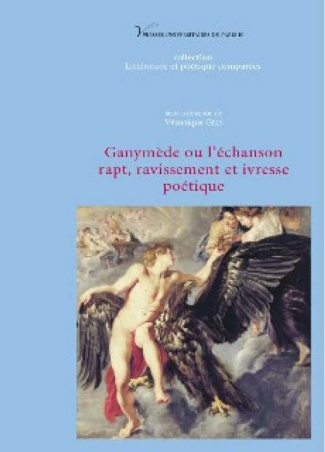
Sur le monde je porterai le regard clair prêté par l'aigle à Ganymède", écrivait Jean Genet dans le Journal du voleur. Enigmatique et silencieux, arraché à la terre par l'aigle de Jupiter, le jeune Troyen devint l'échanson des dieux, immortalisé dans la constellation du Verseau. Avant que la critique contemporaine fasse de lui un emblème de l'homosexualité, Ganymède a inspiré autant les arts figurés (Botticelli, Le Corrège, Michel-Ange, Rubens, Rembrandt, Flatters, Thorvaldsen, Pallez, Turcan...) que, depuis les épisodes homérique et ovidien, une riche littérature: on le retrouve en particulier dans l'?uvre de Dante, de Géngora, de Du Bellay, dans le théâtre de Marlowe et de Shakespeare, à l'âge romantique dans le poème de Goethe devenu lieder de Schubert et de Wolf, dans les poésies de Hölderlin, de Lamartine et de Musset, au siècle suivant dans les ?uvres de Jacques d'Adelswärd-Fersen, de Forster, de Thomas Mann... Ganymède illustre la beauté du corps masculin et son érotisme, mais aussi une idée de la jeunesse éternelle; son rapt peut être une image du sublime, et, par sa fonction d'échanson divin, il incarne une certaine conception de l'inspiration et de l'enthousiasme poétiques dont on trouve un pendant dans les poésies arabe et persane. Les études ici réunies se proposent, dans une perspective comparatiste et pluridisciplinaire, de découvrir la complexité et les enjeux de ce mythe étonnamment moderne.ÉPUISÉVOIR PRODUIT18,00 €


Du même éditeur
-

-
Ernest Hemingway. L'éducation européenne de Nick Adams
Des débuts de la littérature américaine jusqu'au XXe siècle, les écrivains et les intellectuels américains éprouvèrent le besoin de visiter l'Europe pour évaluer la civilisation dont ils étaient séparés et se situer par rapport à elle. Ils croyaient à l'infériorité intellectuelle de l'Amérique et pensaient que leur éducation ne serait complète que lorsqu'ils auraient pris contact avec une civilisation plus ancienne. La tendance à l'expatriation de l'intelligentsia américaine trouve donc son origine dans les liens traditionnels et culturels qui rattachaient le Nouveau Monde au Vieux Monde.ÉPUISÉVOIR PRODUIT43,75 €


