

Hockney's Eye. The Art and Technology of Depiction
David Hockney is the best known and most widely admired painter in the world. This vibrant catalogue accompanies a major exhibition at the The Fitzwilliam Museum and the Heong Gallery in Cambridge, as well as the Teylers Museum in Haarlem, Netherlands. Throughout his long career, David Hockney has insistently explored diverse ways of depicting the visible world. He has scrutinised the methods of the old masters, and explored radical departures from their cherished assumptions The exhibition and accompanying book are the first to focus on this central theme in his art. "Western art" from the Renaissance until at least the late 19th century has been dominated by the depiction of nature. Was this to be accomplished by direct looking (called "eyeballing" by Hockney) or with the assistance of optical theory and devices, such as cameras ? Hockney has experimented with the full range of existing strategies, overtly using perspective in some of his classic pictures and rigorously investigating optical aids for the imitation of nature, including the camera obscura and camera lucida. Yet he has come to reject the photograph as the definitive image of what we see. Along the way, he has identified a "camera culture'' in European painting from 1400, arguing very controversially that the supreme naturalism of painters like Jan van Eyck are the product of optical devices. His book, Secret Knowledge (2001), with its majestic panorama of paintings over the course of five centuries, claims that art historians have missed the central aspect of painters' practice. The "Hockney thesis" has been received more favourably outside the professional world of art history than in it. His own artistic practice has been in vigorous dialogue with his radical thesis, and he has progressively demonstrated new and dynamic ways of characterising the visual world without perspective and other conventional techniques. This quest results a series of joyous challenges to our ways of seeing in the major exhibition in Cambridge at the Fitzwilliam Museum and in the Heong Gallery (Downing College). It will look at the whole span of Hockney's varied career and at the nature of the optical devices he has tested. His vision will be explored in the setting of traditional masterpieces of naturalistic observation, and in the context of modern sciences and technologies of seeing. The first section of the book looks at his thrilling experiments in seeing and representing in broad historical and contemporary contexts. This is followed by discussions of pre-photographic devices for capturing the appearances of things by optical means. The third section includes essays on Hockney's experiments from the perspectives of neuroscience and computer vision. In short, it reveals in a new way the working of Hockney's unique eye.
| Nombre de pages | 184 |
|---|---|
| Date de parution | 15/04/2022 |
| Poids | 1 136g |
| Largeur | 246mm |

| SKU: | 9781913645120 |
| wmi_id_distributeur: | Not set |
| Is Salable (from plugin): | Yes (In Stock) |
| Is Salable (direct MSI check): | Yes (In Stock) |
| Distributor Name: | Par défaut |
| Availability Value: | 0 |
| Availability Label: | Epuisé |
| Match Result: | |
| Default Availability (Config): | 0 - Epuisé |
| Raw Config Mapping: |
Array
(
    [_1772119784121_121] => Array
        (
            [id] => 12707000
            [name] => 12707000
            [availability] => 1
            [activation_attribute] => 1
        )

)
|
| EAN | 9781913645120 |
|---|---|
| Titre | Hockney's Eye. The Art and Technology of Depiction |
| Auteur | Gayford Martin ; Kemp Martin ; Munro Jane |
| Editeur | HOLBERTON |
| Largeur | 246 |
| Poids | 1136 |
| Date de parution | 20220415 |
| Nombre de pages | 184,00 € |
Pourquoi choisir Molière ?
Du même auteur
-

Sabotage !
En 1944, un étonnant "Manuel de sabotage" fut diffusé par les services secrets américains pour aider les mouvements de résistance du monde entier à combattre l'ennemi. Il indiquait comment faire dérailler des trains ou manipuler des explosifs... Mais surtout, de façon plus insidieuse, il détaillait huit manières d'agir de façon stupide et disciplinée afin de paralyser de l'intérieur l'organisation la mieux huilée. Autant de grains de sable pour un bousillage efficace et discret : l'obéissance aveugle, la prise de parole filandreuse ou qui part en vrille, la prudence excessive, les réunions inutiles, etc. Cela vous rappelle des expériences douloureuses ? Consultants de premier plan, les auteurs de cet ouvrage aussi utile qu'amusant montrent en effet comment ces virus continuent de faire des ravages dans nos organisations, en étant cultivés et répandus par des collaborateurs trop zélés. Ils expliquent aussi comment se protéger de ce sabotage souvent involontaire. Cet ouvrage est la première traduction en français d'un livre qui est vite devenu un classique du management aux Etats-Unis. Il s'adresse à tous ceux qui souhaitent combattre les vices cachés des organisations - entreprises ou associations - dont ils ont la charge.EN STOCKCOMMANDER22,90 € -

-
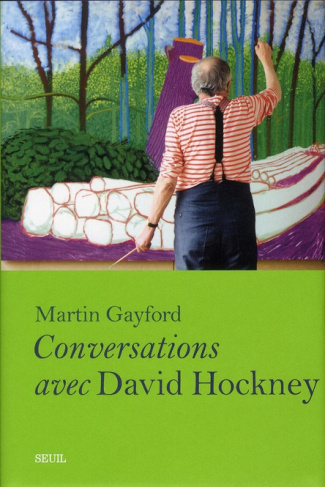
Conversations avec David Hockney
Dans cet ouvrage remarquable, les idées, les anecdotes, les passions et l?humour de Hockneyélaborent son point de vue sur les problématiques et les paradoxes de la représentation d?unmonde en trois dimensions sur une surface plane. Hockney suggère que « dessiner apprend àregarder [et que] plus on dessine, mieux on y voit ». Quels sont les liens qui unissent les imagesque nous fabriquons à la réalité qui nous entoure? Comment l?évolution des technologies a-t-elleaffecté la manière dont les artistes représentent le monde? Et comment apprécier à sa justevaleur le plaisir simple de contempler des arbres, des visages ou des couchers de soleil?Nos deux interlocuteurs ponctuent leur conversation d?observations éclairantes sur nombre d?autresartistes comme Van Gogh ou Vermeer, le Caravage, Monet ou Picasso, et formulent des remarqueslumineuses sur le contraste frappant entre les paysages de la Californie, où Hockney a passé tantd?années, et du Yorkshire, la région de son enfance où il vit à nouveau aujourd'hui.Quelques-uns des artistes qu?il a rencontrés en chemin, notamment Henri Cartier-Bresson et BillyWilder, font des apparitions intéressantes au détour du dialogue.Autoportrait unique et fascinant de l?un des artistes britanniques les plus célèbres et les plusinfluents de son temps, Conversations avec David Hockney deviendra sans nul doute un ouvragede référence sur la nature de la création.ÉPUISÉVOIR PRODUIT28,40 € -

La 1re année de bébé
Vous allez bientôt devenir parent ou vous venez de rentrer de la maternité? Vous craignez d'être un peu dépassé(e) par votre nouveau-né? Félicitations! La 1ère Année de Bébé pour les Nuls est fait pour vous! Mois après mois, des toutes premières heures jusqu'au premier anniversaire, en passant par la fameuse première semaine à la maison, découvrez le mode d'emploi de votre bébé! Vous avez entre les mains un guide complet qui développe tous les changements que Bébé va connaître durant ces douze mois, tant physiquement qu'émotionnellement. Vous y glanerez des astuces pour faire en sorte que la promenade soit une partie de plaisir, le repas un instant privilégié et la nuit... un moment où l'on peut enfin se reposer! Ecrit par des pédiatres, ce livre répond à toutes les questions que vous vous posez. Un livre indispensable pour vivre sereinement ces douze premiers mois si décisifs dans la vie d'une mère (et d'un père!) et d'un enfant.ÉPUISÉVOIR PRODUIT22,95 €


Du même éditeur
-

GOLD OF THE GREAT STEPPE - PEOPLE, POWER AND PRODUCTION
Résumé : This catalogue accompanies an exhibition which presents artefacts from burial mounds of the Saka people of East Kazakhstan, who, over 2, 500 years ago, lived lives rich in complexity. The Saka people occupied a landscape of seemingly endless steppe to the west, bounded by mountains to the east and south. Known to be fierce warriors, they were also skilled craftspeople, producing intricate gold and other metalwork. Their artistic expression indicates a deep respect for the animals around them - both real and imagined. They dominated their landscapes with huge burial mounds of sophisticated construction, burying their horses with elite members of their society. Recent excavations and analyses, led by archaeologists from Kazakhstan, have demonstrated that by looking through a scientific and social lens at what the Saka left behind we can paint a picture of a complex society. We can start to understand how it affected the way people lived, how they travelled, the things they made and what they believed in. Including contributions from experts at Nazarbayev University, Al-Farabi Kazakh National University, and the University of Cambridge, this publication details the results of new archaeological research from East Kazakhstan. It is richly illustrated with photographs of intricate gold artefacts in the Saka-Scythian animal style, landscape and aerial photography of the burial mounds, and details of the excavations and analyses. Grounded in decades of careful study, papers by the two leading Kazakhstani archaeologists of the East Kazakhstan region, Professors Zainolla Samashev and Abdesh Toleubayev, demonstrate current archaeological thinking in Kazakhstan today. These papers are complemented by material from a team of international scholars, which contribute the results of new scientific analyses on the artefacts, and wider Eurasian perspectives on the Saka people and their practice of horse burial.ÉPUISÉVOIR PRODUIT32,00 € -
Charleston: The Bloomsbury Muse
Accompanying an exhibition at Philip Mould & Company, this lavish catalogue tells the story of Vanessa Bell and Duncan Grant's enduring attachment to their home at Charleston Farmhouse, and showcases the work the artists produced between the two world wars. This stunning collection of artwork is beautifully presented alongside illuminating, illustrated essays, an interview and complete catalogue. Vanessa Bell and Duncan Grant's enduring attachment to their home at Charleston Farmhouse, its idyllic surroundings, and constant fl ow of visitors can be witnessed through their art. Beginning with radical modern works infl uenced by European trends - from painted furniture to depictions of food preparation in the kitchen, from the barns to the pond, the people to the household cat - this catalogue tells a story of over thirty years of astonishing artistic productivity. Charleston was not just the Bloomsbury Group's country retreat but a venue for their progressive social self-expression. It was also a family home. Focusing on Vanessa and Duncan's most productive years of creativity, between and including two world wars, this catalogue will explore how Charleston fed their artistic impulses and ideas to produce a glorious canon of art.ÉPUISÉVOIR PRODUIT32,00 € -
-


