

THE GEOPOLITICAL AND GEOSECURITY IMPLICATIONS OF GLOBALISATION
The authors believe that national security is no longer simply national but also transnational and transcultural in its scope, and globalization has a significant role to play in the development of security and strategic agendas at all levels. The pursuit of global security is a transnational phenomenon which is heightened and potentially hindered by the globalization process. This publication proposes an alternative new security principle, which the editor believes is central to the understanding and attainment of lasting security and peace in today's globalized world. The principle, termed "justice-based penta-security," states that "in a globalized world, security is a pentagon of human, environmental, national, transnational and transcultural security, and global security and the security of any one state or culture cannot, therefore, be achieved without good domestic and global governance that guarantees security through justice for all individuals, states, and cultures." Through an examination of the economic, political, environmental, societal, and military links between globalization and securiy, this book provides insight into a complicated and diverse problem while proposing solutions to some of the more pressing issues that states are currently facing. This book contributes an innovative new theory and a unique perspective to the vast literature on globalization and security in a way never before achieved, making it a vital reference to any comprehensive study of these issues.
| Date de parution | 08/12/2006 |
|---|---|
| Poids | 685g |
| Largeur | 150mm |

| SKU: | 9782051020121 |
| wmi_id_distributeur: | Not set |
| Is Salable (from plugin): | Yes (In Stock) |
| Is Salable (direct MSI check): | Yes (In Stock) |
| Distributor Name: | Par défaut |
| Availability Value: | 0 |
| Availability Label: | Epuisé |
| Match Result: | |
| Default Availability (Config): | 0 - Epuisé |
| Raw Config Mapping: |
Array
(
    [_1772119784121_121] => Array
        (
            [id] => 12707000
            [name] => 12707000
            [availability] => 1
            [activation_attribute] => 1
        )

)
|
| EAN | 9782051020121 |
|---|---|
| Titre | THE GEOPOLITICAL AND GEOSECURITY IMPLICATIONS OF GLOBALISATION |
| Auteur | AL-RODHAN NAYEF |
| Editeur | SLATKINE |
| Largeur | 150 |
| Poids | 685 |
| Date de parution | 20061208 |
| Nombre de pages | 0,00 € |
Pourquoi choisir Molière ?
Du même auteur
-
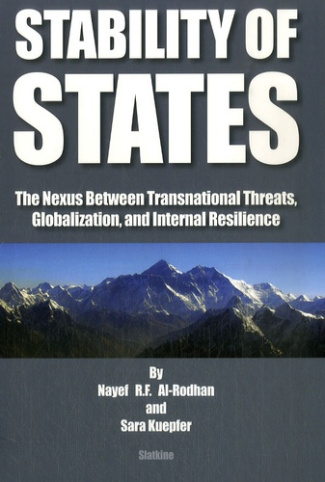
STABILITY OF STATES. THE NEXUS BETWEEN TRANSNATIONAL THREATS,GLOBALIZATION AND INTERNAL RESILIENCE
In this study, the authors contend that in our globalized world the stability of any individual state (irrespective of its size and importance) plays a critical role in the stability of the entire international system. There are multiple ways to achieve state stability, whether through western-style democracies or through other forms of good and effective governance that are in keeping with local cultures and histories. Regardless of whichever system is used, it is critical that there are certain minimal criteria of governance that are adhered to and must include human dignity, equality, and prosperity. This book contributes a timely analysis of ways to achieve and the methods required to maintain global stability and provides a valuable tool to anyone who is interested in true and lasting transnational security.ÉPUISÉVOIR PRODUIT18,00 € -

Futuwah. Traité de chevalerie soufie
En Islam comme dans le monde chrétien médiéval, l'esprit de chevalerie était loin de se réduire à une éthique militaire. Au contraire, la futuwah, c'est-à-dire l'ensemble des traditions, coutumes et pratiques qui constituaient le code de la vie chevaleresque musulmane au Moyen Âge, s'entendait avant tout au sens spirituel et éthique. Véritable initiation, la futuwah amène l'individu à suivre la noble voie du service divin ; elle forme le sommet de la démarche soufie. Le présent livre, traduction d'un texte arabe dû à un auteur d'origine persane du Xe-XIe siècle, Abû Abd al-Rahman ibn al-Husayn al-Sulamî, est commenté par Faouzi Skali, l'un des auteurs de langue française les plus lus sur le soufisme. Futuwah fait partie de ces grands classiques de la spiritualité universelle que l'on relit sans cesse.ÉPUISÉVOIR PRODUIT8,85 € -

A PROPOSAL FOR INCLUSIVE PEACE AND SECURITY
In this era of globalization, a multitude of threats impact the security of populations everywhere. These threats now increasingly transgress the traditional boundaries of states and are often non-military in nature, requiring more comprehensive and multifaceted approaches and policy responses. While every threat is unique in terms of its root causes and remedies, philosophical and conceptual methods exist that offer valuable tools for analysis and potential policy recommendations for states facing such threats. This book presents in a novel way eight such approaches that - when applied against any transnational threat - may help to enhance the effectiveness of states in their pursuit of longterm and durable security.ÉPUISÉVOIR PRODUIT18,00 € -
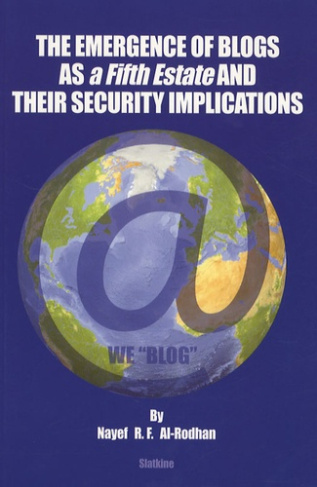
THE EMERGENCE OF BLOGS AS A FITH ESTATE AND THEIR SECURITY IMPLICATIONS
In the past ten years, the spread of the Internet and other advanced technologies has had a dramatic effect on the way people access and perceive information. One of the most revolutionary technological novelties that characterizes the modern "digital revolution" has been the explosion of weblogs. Blogs have impacted numerous facets of international politics including elections, media reporting from zones of conflict, and corporate and congressional policies. They also have potentially significant implications for policy making of the future and for national and global security. This has led to the claim that blogs deserve the title of the "fifth estate," following an analogy with the other four estates that influence modern policy shaping: executive, legislative, and judicial branches of the state and the media. This book methodically analyses the various facets of the modern blogosphere that led the author to support this claim and offers a number of recommendations to further the empowerment of blogs in the global policy arena.ÉPUISÉVOIR PRODUIT18,00 €


